Safe Pest Control in Surprise: Protecting Your Home, Kids and Pets
Safe pest control means lowering risk, not promising zero risk. No pesticide is risk-free, so the safest approach in Surprise starts with an inspection. It seals the gaps pests use to get inside, places products only where pests travel, follows the label exactly, and prepares your household before and after each visit. For West Valley homes, sealing out bark scorpions does much of that work.
Key Takeaways
- Lower risk comes from how the work is done: inspection, sealing entry points and targeted placement instead of broad spraying.
- Keep children and pets off treated areas until the product label says it is safe to return.
- Sealing a Surprise home against scorpions reduces how much treatment the house needs over time.
What does 'safe' pest control mean, and what is the safest approach?
The safest pest control is integrated pest management (IPM). You find the pest, fix the conditions that let it in, and use a pesticide only where and when it is needed. Safe never means risk-free. It means the least exposure for your family that still solves the problem.
The EPA's integrated pest management principles describe IPM as a lower-risk approach. It is built on inspection, monitoring and pest-specific controls, such as sealing entry points, before broader pesticide use. The EPA's Citizen's Guide to Pest Control and Pesticide Safety adds that households cut risk to children and pets by using products only as directed and by choosing least-toxic options first. Every product used on your home must be EPA-registered, and the label is the law.
How does a lower-risk treatment work: inspection, sealing and targeted placement?
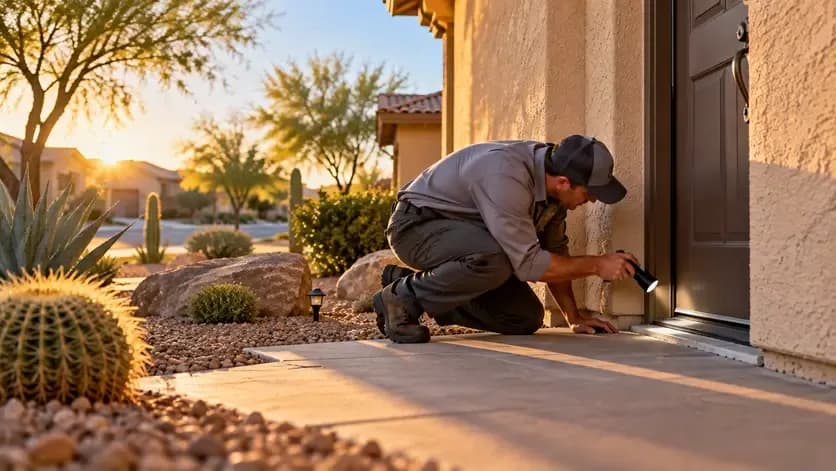
A lower-risk treatment works in order. The technician inspects and identifies the pest, then seals the entry points. After that, product goes only into the cracks, voids and paths the pest uses. The CDC's overview of integrated pest management describes this same mix of inspection, sanitation, exclusion and targeted pesticide use to keep risk to people low.
Here is how that sequence usually runs on a house:
- Inspection: checking the perimeter, garage, door sweeps, weep screeds, plumbing penetrations and irrigation boxes for activity.
- Identification: naming the pest, because a scorpion, a cricket and an ant each call for a different response.
- Sealing and sanitation: closing gaps and removing the debris, clutter and standing water that shelter pests.
- Targeted placement: applying product to hiding spots and travel routes, not across open floors.
- Monitoring: checking whether activity drops and adjusting the plan.

If you want this approach at home, our general pest control service is the place to start. Ask us how each step applies to your house.
How do you keep kids and pets safe before, during and after a treatment?
Keep children and pets away from treated areas until the label says it is safe to go back. Prepare the house before the visit so nothing gets treated by accident. The EPA's do's and don'ts of pest control says residents should wait for re-entry per label instructions both before and after a treatment.
A simple routine covers most homes:
- Before: pick up toys, pet bowls and bedding. Cover fish tanks and move pets to a closed room or off-site. Ask the technician which areas will be treated.
- During: keep kids and pets inside, or away from the section being worked. Close windows near exterior treatment.
- After: wait for treated surfaces to dry or for the label time to pass. Keep pets off treated gravel and turf until then. Wash hands after yard play.
Pet owners here also deal with pests that ride in on animals. Our guide to protecting pets from fleas and ticks in Arizona covers that side of keeping them safe.
Why do scorpions and other desert pests change the plan in Surprise?
Scorpions change the plan because spraying alone does little to keep them out. Bark scorpions climb walls and slip through gaps that look too small to matter. In Surprise, sealing the house does much of the protective work and cuts how much product the home needs.
The CDC/NIOSH guidance on insects and scorpions notes that scorpions are a notable hazard in warm, arid regions and recommends precautions against stings. That matters most for crawling toddlers and curious pets. Around a West Valley home, the usual entry points are gaps under doors, openings around plumbing and wires, weep screeds and unscreened vents.
Our Scorpion Home Seal service is the exclusion work that closes those gaps. If you want to start on your own, our guide to scorpion-proofing an Arizona home walks through the steps. Patrick's Home Solutions has served the Phoenix West Valley since 2016.

What drives the cost of a safer pest control plan?
Price depends on your home, so we give you a quote after we've inspected it. What moves the price is how much inspection, sealing and follow-up your home needs. The pest itself matters too.
The main drivers:
- Home size and lot: more perimeter, more gaps and more yard to inspect.
- Pest pressure and species: scorpion activity usually calls for more exclusion work than an occasional ant trail.
- Initial service versus maintenance: a heavier first visit, then smaller recurring visits on a set schedule.
- How much sealing is needed: a sealing job adds cost up front but can reduce how much treatment the house needs later.
- Follow-up visits: some problems take more than one trip to bring under control.
For pricing detail, read our Arizona pest control cost guide.
What questions should you ask a pest control company before you hire?
Ask about licensing, insurance, and the exact products and methods the company plans to use. The EPA's tips for selecting a pest control service names those as the core questions for any consumer.
Take this list into every quote:
- What is your Arizona license number, and are you insured?
- Do you inspect before you treat?
- Which products will you use, and where will they go inside and outside?
- How long must kids and pets stay off treated areas?
- Do you seal entry points, or only spray?
- How often will you come back, and why that schedule?
- Which pests do you not treat?
Our answers are simple. Patrick's Home Solutions is licensed and insured under Arizona license #9794. Timing matters too, so our year-round Surprise pest control guide explains how the seasons shape a plan.
When you are ready, contact us to set up an inspection.
Sources
- Integrated Pest Management (IPM) Principles - U.S. Environmental Protection Agency, retrieved 2026-09-26
- Citizen's Guide to Pest Control and Pesticide Safety - U.S. Environmental Protection Agency, retrieved 2026-09-26
- Do's and Don'ts of Pest Control - U.S. Environmental Protection Agency, retrieved 2026-09-26
- Tips for Selecting a Pest Control Service - U.S. Environmental Protection Agency, retrieved 2026-09-26
- Insects and Scorpions at Work - CDC/NIOSH, retrieved 2026-09-26
- What Is Integrated Pest Management? - CDC, retrieved 2026-09-26
Ready for a Pest-Free Home?
Don't wait for pests to become a bigger problem. Contact Patrick's Home Solutions today for fast, reliable service across the Phoenix Valley.