How to Scorpion-Proof Your Arizona Home: 4 Essential Steps
Scorpion-proofing a West Valley home means four things: sealing structural entry points, eliminating harborage zones, maintaining a chemical barrier, and checking the system seasonally. The University of California IPM Program confirms bark scorpions enter through gaps as small as 1/16 inch — smaller than most door sweeps seal by default. Here's how to address all four.
Key Takeaways
- The University of California IPM Program states bark scorpions "need only a crack of 1/16 inch to enter a home" — most standard door seals and caulk applications leave access points that meet this threshold
- In 2018, a peer-reviewed study in the Journal of Medical Toxicology found 86.5% of Arizona scorpion stings occur indoors; 42.5% of those happen in the bedroom
- The University of Arizona Extension's June 2018 IPM Newsletter called pest-proofing "by far the most effective way to reduce scorpion contact" — ahead of chemical treatment alone
- West Valley homes are stucco, not brick: weep screeds (not weep holes) run the full base of every exterior wall and are the most commonly missed entry point in the region
Step 1: What Entry Points Do Scorpions Actually Use to Get Inside?
The University of California IPM Program confirms that bark scorpions can enter through a gap as narrow as 1/16 inch — a threshold most standard door sweeps and caulk applications don't reliably close. That's the starting point for every sealing project. Every gap you leave open is an open door, regardless of how well you address the other entry points. See our complete scorpion control guide for Surprise, AZ for location-specific context on why West Valley properties face higher pressure than most.
Every generic "scorpion-proofing" guide you'll find online talks about "weep holes." That term refers to small, isolated holes in the mortar joints of brick construction — they let moisture drain from the wall cavity. If you live in Surprise, Peoria, El Mirage, or anywhere in the Phoenix West Valley, your home almost certainly isn't brick. It's stucco. Stucco homes don't have weep holes. They have weep screeds.
A weep screed is a continuous drainage channel that runs the entire length of the stucco wall at its base. It doesn't have individual holes — it's an open channel along the full perimeter. You can't caulk it shut. Doing so traps moisture inside the stucco system and causes the stucco to fail. The correct fix is fine mesh screen installed inside the screed channel. That blocks scorpion access while preserving the drainage function that keeps your exterior wall intact. This is the step that separates a real seal from a partial one.
Weep screeds run the full perimeter of the stucco wall and must be screened, not caulked. If you see a generic guide suggesting you fill weep holes with caulk, that guide was written for brick construction and doesn't apply to your home.
Garage door sweep — the rubber seal at the door base — loses flush contact with the threshold as it ages. Most homeowners don't notice this until a scorpion comes through. Test it yourself: slide a business card under the closed door along the full width. If it moves freely at any point, the seal is compromised. A replacement sweep is a straightforward hardware job.
AC refrigerant line penetrations are where the lines enter the exterior wall, often through an unfoamed or poorly foamed gap left at original installation. Use a foam collar correctly sized to the pipe. Don't rely on a thick foam blob around the outside — that's cosmetic, not functional.
Dryer vent and exhaust transitions — check where the vent pipe exits the wall. The collar at the wall face is the point to inspect. A secured vent cap on the outside doesn't mean the interior collar is sealed.
Window frame perimeter caulk degrades in Arizona heat cycles faster than most manufacturers' specs suggest. Inspect every frame annually. Re-caulk any section where you can see or feel a gap between the frame and the stucco.
Flat roof note: Flat-roof homes are common throughout the West Valley. Parapet walls and roofline transitions create gaps where the stucco meets the roof membrane. Any open joint at that transition is a potential path for scorpions moving from the roof into the wall void.
What shouldn't you do? Don't caulk weep screeds shut. Don't rely on expanding foam alone for large pipe penetrations — foam shrinks in Arizona's heat cycles and pulls away from the pipe wall. Don't skip the garage door threshold because it looks fine from the outside.
Step 2: Which Scorpion Harborage Zones Should You Clear First?
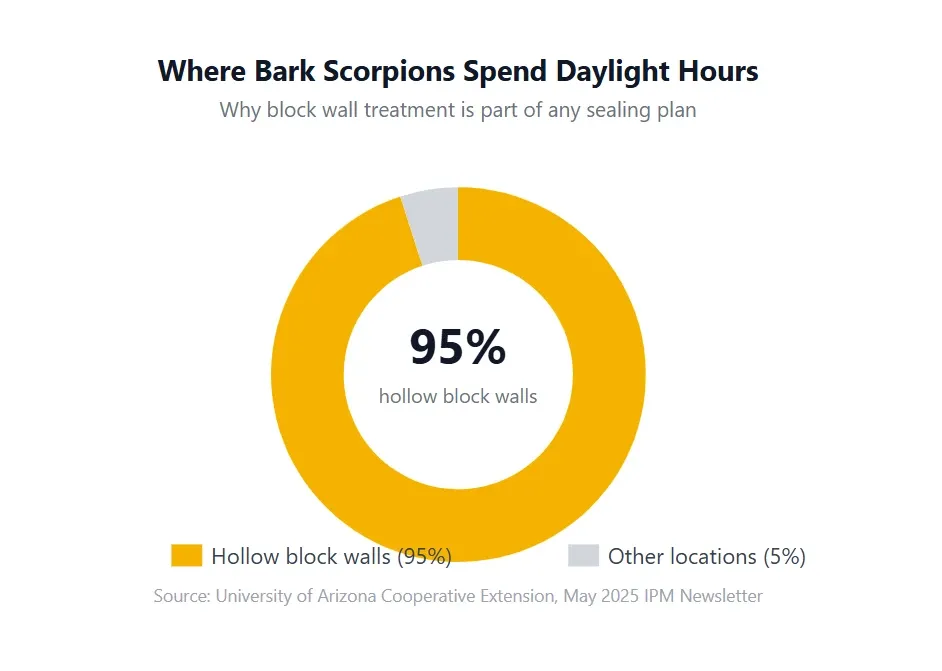
In its May 2025 IPM Newsletter, the University of Arizona Cooperative Extension confirmed that 95% of bark scorpions prefer hollow block walls for harborage. Every yard in a West Valley neighborhood is enclosed by those block walls. Clearing the zone immediately adjacent to them reduces the population pressure pushing against your sealed home — and the monsoon season pest prep guide covers how that pressure spikes after summer storms.
Exterior harborage is easier to eliminate than most homeowners expect. Rock mulch placed directly against the foundation gives scorpions a sheltered void just inches from the weep screeds. Wood piles stacked against block walls, pool equipment enclosures, and any debris at the wall base all serve the same function. Clear a 12-inch buffer zone at the foundation and you've removed their staging area.
Interior harborage gets less attention but matters just as much. Garage floor clutter — cardboard boxes, stored bins without sealed lids, anything that creates a dark ground-level void — gives scorpions a resting place if they do get inside. Towels, shoes, and clothing left on the floor are a known risk: scorpions shelter in static fabric during daylight, which is why most stings happen at night when the clothing is picked up or worn. Under-sink cabinet spaces with any unsealed pipe penetrations to the exterior are another common indoor harborage point.
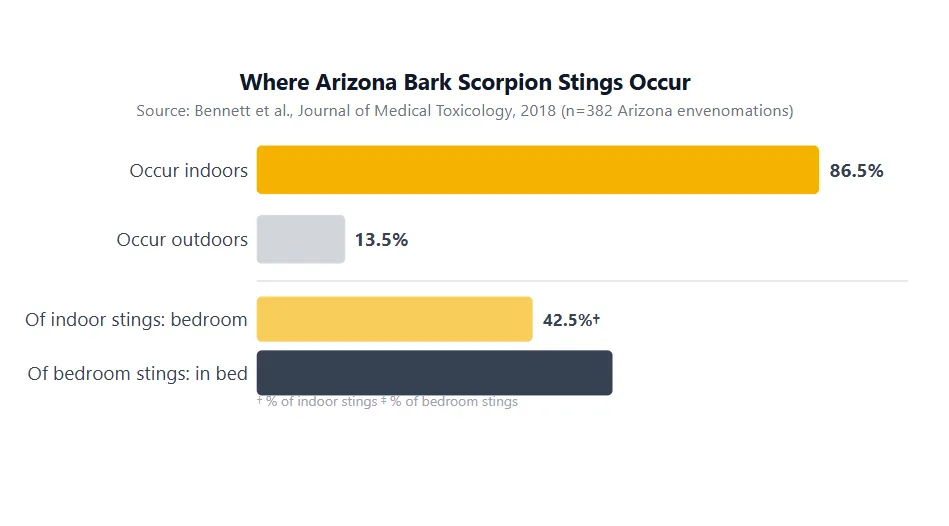
Scorpion stings are an indoor problem — 86.5% occur inside the home, with the bedroom the single highest-risk location.
Step 3: Apply and Maintain a Chemical Barrier
In its June 2018 IPM Newsletter, the University of Arizona Extension called pest-proofing "by far the most effective way to reduce scorpion contact and potential scorpion stings." That same newsletter confirmed that chemical barrier treatment is the necessary partner. Sealing stops access; treatment kills active scorpions that cross the treated perimeter. Neither works as well without the other. See our scorpion control services page and Surprise AZ pest control service area for details on what a quarterly plan covers.
What barrier treatment covers: The application targets the perimeter foundation, block walls, eaves, and harborage zones. A residual insecticide creates a contact kill zone for any scorpion moving across treated surfaces. Effective duration runs 60-90 days under normal conditions, which is why quarterly retreatment is the standard schedule for West Valley properties.
What treatment doesn't do without sealing: Residual treatment doesn't reach scorpions resting inside hollow block walls during daylight hours. It doesn't stop entry through structural gaps that haven't been sealed. And after any significant rain event, the barrier can dilute within 24-48 hours — which is exactly when scorpion activity spikes.
Is there a way to see where your population pressure is heaviest before you treat? Yes. In its May 2025 IPM Newsletter, the University of Arizona Extension recommends conducting UV light inspections "several times during summer months between 8-11pm." Bark scorpions glow bright blue-green under ultraviolet light. A UV scan at night shows you where they're active and gives you a baseline for measuring treatment effectiveness.

Step 4: How Do You Keep a Scorpion-Proofed Home Protected Year-Round?
As of 2026, the National Park Service's Arizona bark scorpion profile confirms this species lives 5–7 years. That matters because a sealed home doesn't stay permanently protected after one visit. Arizona's extreme heat cycles degrade caulk and foam. Ground shifting opens gaps at the stucco base. New construction on adjacent parcels displaces fresh scorpion populations into your neighborhood every season. The system needs annual checks to stay effective.
Spring (February-March): Inspect weep screeds and garage door sweeps before the season starts. Schedule spring perimeter treatment before scorpion activity begins. Responding to a first sighting means you've already lost some ground.
Post-monsoon storm: After each significant monsoon event, check the foundation perimeter and block wall bases. Rain shifts soil and can open new gaps at the stucco base. Run a UV scan in the week after a storm if indoor sightings increase.
Fall (September-October): Scorpions cluster in block walls to overwinter. Treating before that clustering period happens is more effective than treating after they've settled in. Inspect for any entry points that summer heat cycling may have opened.
When to re-inspect even if sealed: Any adjacent grading or new construction (scorpion displacement is real and well-documented), any exterior renovation that adds new penetrations, and any resumption of indoor sightings after a confirmed seal.
DIY vs. Professional Scorpion-Proofing — What's the Real Difference?
Most homeowners can handle 2 of the 5 critical entry points on their own. The other 3 require professional identification and correct materials to be effective. The risk of a partial seal isn't just wasted effort — it creates a false sense of security while still allowing scorpion access through the missed point. See our professional scorpion home sealing service and year-round pest control guide for Surprise and the West Valley for the full picture.
What homeowners can do on their own:
Garage door sweep replacement uses standard hardware and doesn't require professional tools or technique. Yard harborage clearance — moving rock mulch away from the foundation, clearing debris from block wall bases — is straightforward manual work. Annual window frame caulk inspection and touch-up is achievable with basic supplies and a ladder.
What requires professional assessment:
Weep screed screening uses a stucco-specific technique. The wrong mesh type or incorrect installation method blocks drainage and creates a different problem. Roofline gap identification on flat-roof homes isn't visible from ground level. And identifying all utility penetrations through exterior walls — AC lines, dryer vent, plumbing supply — requires inspection from both inside and outside the home.
The partial seal risk: Here's the scenario that plays out most often. A homeowner screens the weep screeds correctly but leaves the AC refrigerant line penetration unfoamed. Scorpions continue entering through that open point. The homeowner concludes the sealing "didn't work" and stops. The actual issue was one missed point — but without a complete inspection, it looks like the whole approach failed.
──────────────────────────────────────────────────
Ready to Get Your Home Professionally Sealed?
Scorpion-proofing a West Valley stucco home starts with identifying every structural entry point — including the weep screeds that most generic guides completely miss — and using the right material for each one. A partial seal still lets scorpions in. A thorough seal stops them.
Patrick's Home Solutions provides licensed scorpion home sealing for Surprise, Peoria, El Mirage, Glendale, and the surrounding Phoenix West Valley. AZ ODA License #9794. BBB A+ accredited since 2020.
Call (623) 640-0405 or visit our scorpion home sealing service page for scheduling details.
──────────────────────────────────────────────────
Frequently Asked Questions
Does scorpion home sealing actually work?
When done correctly — with every entry point sealed using the right material — yes. The University of Arizona Extension's June 2018 IPM Newsletter called pest-proofing "by far the most effective way to reduce scorpion contact." Most clients who combine professional sealing with quarterly treatment report a significant drop in indoor encounters. The word "correctly" matters: a partial seal that misses weep screeds or utility penetrations won't deliver the same outcome.
How long does scorpion home sealing last?
The physical materials — mesh screening, foam collars, replacement door sweeps — last multiple years under normal conditions. Annual inspection is recommended to catch any gaps opened by Arizona's heat cycling, ground shifting, or adjacent construction. The sealing itself is a long-term investment; the quarterly chemical treatment that complements it requires renewal every 60-90 days.
What is the most common way scorpions get into a house in Arizona?
In West Valley stucco homes, weep screeds are the most consistently missed entry point. They run the full length of every exterior stucco wall at the base and can't be caulked shut without damaging the wall system. Other common points: garage door sweeps that don't contact the threshold, AC refrigerant line penetrations, and dryer vent transitions. As of 2026, the UC IPM Program's Scorpions Pest Notes confirms bark scorpions enter through gaps as small as 1/16 inch.
Can I scorpion-proof my home myself?
Partially. Homeowners can replace a garage door sweep, clear yard harborage, and re-caulk window frames annually — and these are worth doing. The entry points that require professional assessment are weep screed screening (a stucco-specific technique that requires the right mesh and installation method), roofline gaps on flat-roof homes, and all utility penetrations through exterior walls. A partial DIY seal that skips weep screeds leaves the most common entry point open.
How much does scorpion home sealing cost in Arizona?
Pricing depends on home size, perimeter length, the number and complexity of entry points found during inspection, and whether sealing is combined with a quarterly treatment plan. Patrick's doesn't publish one-size pricing because stucco homes vary significantly in weep screed exposure and utility complexity. Call (623) 640-0405 for a free estimate specific to your home.
──────────────────────────────────────────────────
The four steps work together — sealing closes the door, harborage elimination removes the waiting area, chemical treatment kills what's already outside, and seasonal maintenance keeps the system intact. Miss any one step and the others underperform. The stucco weep screed is the step that generic guides consistently miss, and it's the one that determines whether the rest of the work holds.
Also on the Patrick's Home Solutions blog:
- Complete scorpion control guide for Surprise, AZ
- Year-round pest control for West Valley homes
- Arizona monsoon pest control prep guide
Written by Patrick Hagan, Licensed Pest Control Operator | AZ ODA License #9794 | ROC #356260 Patrick's Home Solutions has served Surprise, AZ and the Phoenix West Valley since 2016. BBB A+ Accredited. 4.9 stars across 432+ Google reviews.
Sources
1. University of California IPM Program, Scorpions Pest Notes, retrieved 2026-05-29, https://ipm.ucanr.edu/PMG/PESTNOTES/pn74110.html
2. University of Arizona Cooperative Extension, IPM Newsletter: June 2018 — Managing Scorpions, retrieved 2026-05-29, https://acis.cals.arizona.edu/community-ipm/home-and-school-ipm-newsletters/ipm-newsletters/2018/07/16/june-2018---managing-scorpions
3. Bennett R.G. et al., "Factors Contributing to Scorpion Envenomation in Wilderness Settings," Journal of Medical Toxicology, 2018, retrieved 2026-05-29, https://pmc.ncbi.nlm.nih.gov/articles/PMC6314927/
4. University of Arizona Cooperative Extension, IPM Newsletter: Scorpion Season Is Here!, May 2025, retrieved 2026-05-29, https://acis.cals.arizona.edu/community-ipm/home-and-school-ipm-newsletters/ipm-newsletters/2025/05/16/scorpion-season-is-here!
5. University of Arizona Extension, Scorpions of the Desert Southwest United States, published May 2018, retrieved 2026-05-29, https://acis.cals.arizona.edu/community-ipm/community-ipm-output/publications/publications-view/scorpions-of-the-desert-southwest-united-states
6. National Park Service, Arizona Bark Scorpion, retrieved 2026-05-29, https://www.nps.gov/articles/bark-scorpion.htm
About the author

Patrick Hagan
Owner, Patrick's Home Solutions
Patrick Hagan is the owner of Patrick's Home Solutions, a licensed and insured pest, wildlife, weed, and pigeon control company (AZ Lic# 9794) serving the Phoenix West Valley since 2016. The team specializes in identification-first, exclusion-based pest control that keeps cockroaches, scorpions, rodents, and other pests out of West Valley homes.
Read Patrick's storyReady for a Pest-Free Home?
Don't wait for pests to become a bigger problem. Contact Patrick's Home Solutions today for fast, reliable service across the Phoenix Valley.