Pest Control in Surprise, AZ: The Complete Year-Round Guide
Year-round pest control in Surprise, AZ means quarterly perimeter treatment covering scorpions, ants, pack rats, spiders, and more — combined with specialty services for high-density threats unique to the West Valley. Surprise's position at the edge of the Sonoran Desert and its mild winters mean there's no true off-season for the pests that live here.
Key Takeaways
- In its May 2025 IPM Newsletter, the University of Arizona Cooperative Extension confirmed bark scorpions remain active whenever nighttime temperatures stay above 70°F — a threshold met most of the year in Surprise
- General quarterly pest treatment and specialty scorpion service address different threats; most high-pressure Surprise properties need both
- Prasada, Surprise Farms, and the Waddell corridor carry the highest pest pressure of any Surprise neighborhoods due to active desert-interface construction
- In July 2024, the Arizona Department of Health Services confirmed 11 hantavirus cases in Arizona — 6 fatal — with pack rats as the primary carrier; garage and attic contact is the main exposure route
Why Does Surprise, AZ Have Year-Round Pest Pressure?
In 2026, Surprise passed approximately 180,000 residents and continues to grow at more than 3% annually, according to World Population Review analysis of U.S. Census Bureau data. Every subdivision graded into formerly undeveloped Sonoran Desert adds more homes at the edge of active desert habitat. That's not a coincidence. It's the mechanism that makes Surprise one of the highest-pressure pest environments in the country.
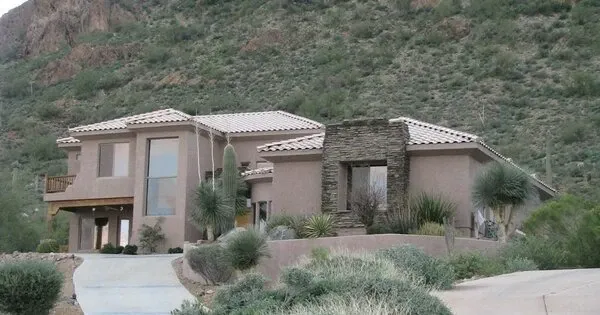
Grading a new subdivision doesn't relocate scorpions, pack rats, or other desert wildlife. It displaces them into the nearest available shelter, which is often the just-finished home next door. The newer the development, the more intense that displacement pressure in the first few seasons. Prasada is the clearest current example: active construction continues adjacent to completed homes, creating a rolling scorpion displacement front that moves block by block.
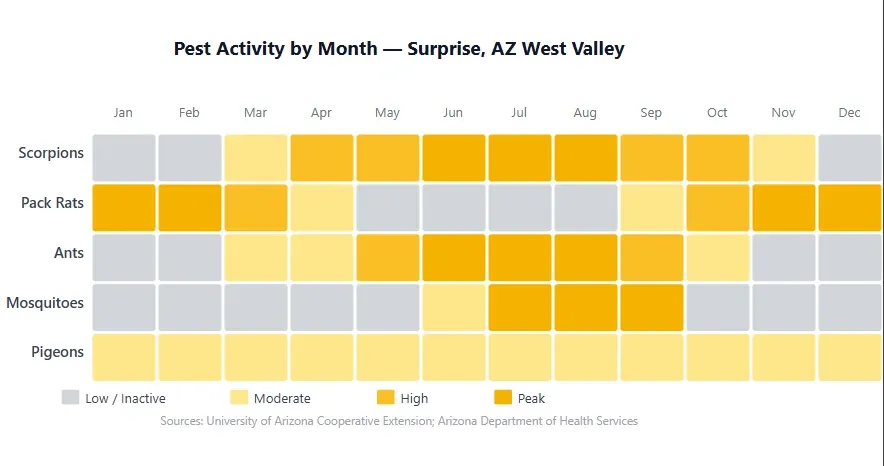
Arizona's low-desert winters don't produce the hard frost that kills off insect populations in colder climates. In its May 2025 IPM Newsletter, the University of Arizona Cooperative Extension confirmed that Arizona bark scorpions remain active in low-desert areas whenever nighttime temperatures stay above 70°F — a threshold Surprise meets on most nights from March through October, and on warm evenings throughout the winter months. Scorpions cluster in block walls during the coldest weeks, but they don't die off. They wait.
Every June through September, monsoon rains flush rodents from desert wash corridors into residential areas, trigger mass cricket and ant hatching near structures, and increase scorpion foraging as prey insect populations surge. Scorpion sting calls to Banner Poison Center consistently spike during monsoon months — a direct reflection of how those rainfall events amplify human-scorpion contact across the Valley.
That combination of desert displacement, mild winters, and seasonal monsoon amplification is why Surprise carries the highest bark scorpion sting rate of any major U.S. city. It's not bad luck. It's geography meeting construction timing.
What Are the Most Common Pests in Surprise, AZ Homes?
Six pest categories account for the overwhelming majority of service calls across the West Valley. Understanding each one helps you match the right treatment to the right threat.
Bark scorpions are the pest that defines Surprise more than any other. In its May 2025 IPM Newsletter, the University of Arizona Cooperative Extension noted that Arizona's Desert Southwest is home to more than 50 scorpion species — but only the bark scorpion (Centruroides sculpturatus) poses a medical threat. Per the University of Arizona Extension's Scorpions of the Desert Southwest United States publication from 2018, 95% of scorpions prefer hollow block walls for harborage. That makes Surprise's universal perimeter wall construction a system-wide harborage network spanning every neighborhood in the city.
Pack rats (woodrats) carry a health risk that goes well beyond property damage. In July 2024, the Arizona Department of Health Services issued a Health Alert Network notice confirming 11 hantavirus cases in Arizona — 6 fatal. Pack rats (Neotoma spp.) are the documented carrier. Exposure comes primarily from disturbing dried droppings or nesting material in garages, attic spaces, and stored items. Pack rats build middens — dense nesting piles — in rock landscaping, vehicle engine bays, and shed corners throughout Surprise.
Roof rats are a separate problem from pack rats, and treating one as the other produces poor results. The University of Arizona Extension's How to Identify and Discourage Roof Rats publication confirms roof rats are an established Phoenix metro pest. Unlike pack rats, roof rats are urban in origin. They colonize attic insulation, citrus trees, and hollow block walls, moving overhead rather than at ground level. A roof rat problem often isn't obvious until attic inspection reveals the insulation damage and droppings concentrated near roofline entry points.
Ants forage year-round in Surprise, with multiple species active across different microhabitats. Harvester ants and fire ants are both documented near newer desert-interface developments. Ant activity surges dramatically after monsoon rains as colonies expand foraging territory. Rock landscaping — standard throughout Surprise — provides ideal nesting substrate directly adjacent to the home's foundation.
Pigeons have become a growing problem across the West Valley as solar adoption increases. Feral pigeons nest under solar panels, on rooflines, and in HVAC equipment. Phoenix metro's feral pigeon population has grown steadily, driven by year-round breeding conditions that don't exist in colder climates. Accumulated pigeon droppings carry health risks and create measurable solar panel efficiency losses — a concern that's only becoming more relevant as Surprise's solar penetration rate rises.
Crickets and spiders operate as a pest pairing that surprises many homeowners. Cricket populations explode after monsoon rains, typically peaking in August and September. Dense cricket populations near structures attract black widow spiders, which are a legitimate secondary threat in garages, block wall gaps, and cluttered storage areas. This pattern — crickets drawing spiders in — repeats in Surprise homes through early fall every year.
What Does a Patrick's Pest Control Plan Actually Include?
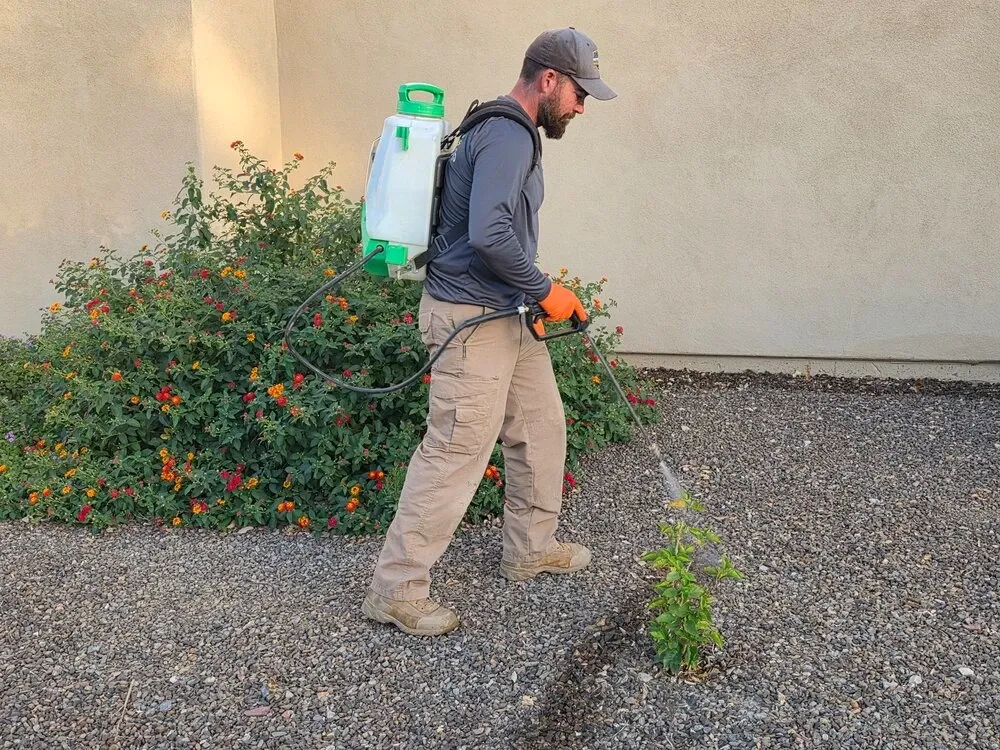
A standard quarterly visit covers six specific deliverables — not a generic "treatment." Exterior residual treatments remain active 60–90 days per industry standard; quarterly service places the retreatment date exactly at the outer edge of that window, with no safety buffer. Understanding what's included helps you know what to expect at every visit.
A standard quarterly visit includes:
- Full exterior perimeter treatment covering the foundation, eaves, block walls, weep screeds, and window frames
- Crack-and-crevice treatment at documented entry points identified during the inspection
- Granular ant bait placement in active foraging zones along the foundation and rock landscaping
- Spider web removal from eaves, entry areas, and outdoor fixtures
- Treatment observation report noting what was found, what was treated, and any structural concerns flagged for the homeowner
Professional-grade residual insecticides used on every visit are registered for Arizona residential use under AZ ODA License #9794. They're safe for family and pets once the treated surface dries — typically 30–60 minutes after application. If you're pregnant or have an infant at home, let us know when booking. Interior applications can be adjusted and ventilation managed on request.
Here's what most homeowners don't realize about quarterly scheduling. A treatment applied in March expires in late May or early June — right as monsoon season begins and pest pressure ramps to its annual peak. A treatment applied in June is at full strength through August, covering the hottest and most active period of the year. It's not just how often you treat. It's when. High-pressure neighborhoods — Prasada, Surprise Farms, Waddell — see better outcomes when the monsoon window is covered by a fresh application rather than a treatment entering its final weeks.
If you're seeing active scorpion intrusions despite regular quarterly service, two additional options work alongside the base plan: scorpion-specific treatment that reaches block wall harborage zones the perimeter product doesn't penetrate, and home sealing that closes structural entry points permanently. For properties with pigeon activity on rooflines or solar panels, pigeon prevention is a separate scope. Rodent concerns — pack rats or roof rats — fall under wildlife and rodent exclusion. Weed pressure that's creating harborage zones along the foundation is addressed through our weed control service.
Which Surprise Neighborhoods Have the Highest Pest Pressure?
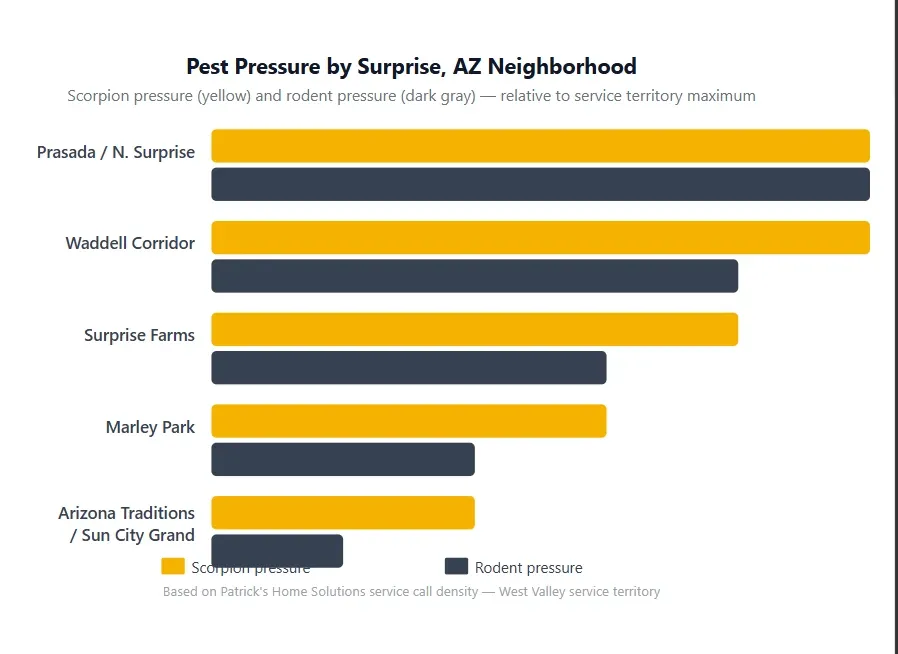
Risk level tracks desert proximity and construction age more than any other variable. Newer developments at the desert edge see the most pressure; established interior communities see less. Here's how the neighborhoods Patrick's serves most frequently compare.
Prasada and North Surprise represent the highest-pressure service zone we cover. Active grading continues adjacent to completed homes; scorpion and pack rat displacement is most intense in the first one to three seasons of a new build. If you've just moved in — especially if you relocated from outside Arizona — schedule before the first sighting. Don't wait for the problem to show up indoors.
Surprise Farms and Rancho Gabriela back up against undeveloped desert to the north and northwest. Consistent scorpion and pack rat pressure runs year-round. Seasonal flooding of adjacent desert washes during monsoon pushes rodents toward residential foundations as surface-level shelter disappears. Pack rat activity here is more persistent than in interior neighborhoods, and midden construction in rock landscaping is common.
The Waddell Corridor (near Hwy 303) is a semi-rural desert interface — the highest combined pest pressure in our service territory. Scorpion activity is year-round, pack rat midden populations are common in boulder and rock landscaping, and a property profile here almost always warrants both perimeter treatment and home sealing. This isn't a once-a-year pest control area. It requires consistent coverage with no gap months.
Marley Park is a more established community with mature landscaping and a managed tree canopy. Displacement pressure from fresh grading is lower than newer neighborhoods. That said, pigeon roosting on rooflines and solar panels is increasingly common. Rock mulch along perimeter fencing creates a consistent scorpion harborage zone that surprises homeowners who assume established neighborhoods are lower-risk.
Arizona Traditions and Sun City Grand are well-maintained communities where ants are the primary recurring complaint. Scorpion pressure is moderate. Rock groundcover throughout HOA common areas creates harborage adjacent to perimeter block walls, but regular quarterly treatment keeps activity manageable for most residents.
For full coverage details across all communities we serve, visit our full Surprise AZ service area.
What Changes During Arizona Monsoon Season?
Monsoon rains — arriving in late June and running through September — are the single biggest amplifier of pest activity in the Phoenix West Valley. They trigger scorpion foraging surges, flush pack rats from desert washes, and cause mass cricket hatching near structures. The question isn't whether monsoon affects pests. It's whether your current service schedule accounts for it.
June marks the inflection point. Nighttime temperatures reach their annual peak, pushing scorpion foraging to maximum frequency. The first monsoon cells typically arrive in late June, triggering the initial cricket emergence near exterior lights and garage entries. Homeowners on a spring-only treatment schedule are often unprotected during this exact transition.
July and August are peak activity months across almost every pest category. Crickets hatch in large numbers after the first heavy rain events. Pack rats displaced from flooded desert washes seek shelter near residential structures. Mosquito populations surge around standing water in pool equipment, low planters, and ground irrigation zones. Scorpion foraging is most intense during these two months — and it happens at night, which is when people and pets are most vulnerable.
September is the monsoon tail. Roach populations spike from persistent moisture in shaded foundation areas and block wall bases. Ants forage aggressively before temperatures begin to drop. Scorpion activity remains significant in desert-interface neighborhoods through mid-October, well past when many homeowners assume the season has wound down.
What this means for service timing is straightforward. A quarterly schedule with treatments in April and July provides maximum coverage through the monsoon window. A March-and-June schedule leaves August and September — two of the three highest-activity months of the year — with a treatment that's past peak efficacy. Timing matters as much as frequency.

Do You Need Both General Pest Control and Scorpion Specialty Treatment?
For most Surprise homeowners — yes. General quarterly service and scorpion specialty treatment address different sides of the same problem, and combining them is what produces consistent indoor scorpion-free results on high-pressure properties. Using only one or the other leaves a documented gap.
What general quarterly treatment covers: Broad-spectrum residual insecticide at the exterior perimeter kills ants, spiders, crickets, roaches, and scorpions that contact treated surfaces. It's effective for everything that walks across the treated zone. But bark scorpions spend daylight hours inside hollow block walls and interior wall voids — areas general perimeter products don't penetrate. A scorpion resting in a block wall cavity isn't exposed to the treatment at the wall face. It's protected by the wall itself.
What scorpion specialty treatment adds: Targeted application to block wall interiors, weep screeds, and accessible wall void entry points. UV inspection before treatment to identify active harborage zones. Quarterly scorpion-specific barrier maintenance calibrated to scorpion seasonal behavior rather than the broader pest activity calendar. This is the layer of service that reaches bark scorpions where they actually live — not just at the surface they cross at night.
When to add home sealing: Multiple indoor scorpion sightings despite active quarterly treatment — particularly if you've found them in bedrooms, clothing, or bedding — typically indicate structural access points that chemical treatment alone won't close. A professional home seal closes weep screeds, utility penetrations, garage door seal gaps, and roofline transitions permanently. It doesn't expire. Renewed quarterly treatment manages the population outside; the seal closes the door between that population and your living space.
Per the University of Arizona Extension's May 2025 IPM Newsletter, bark scorpions in low-desert areas remain active whenever nighttime temperatures exceed 70°F. General perimeter treatment creates a contact kill zone at the treated surface. Bark scorpions in hollow block walls or wall voids during daylight aren't exposed to perimeter products until they move. That's why scorpion-specific quarterly service and home sealing service produce better results than either one alone — they address different phases of the problem.
For an overview of how weed control timing affects harborage conditions in your yard, the Arizona weed control timing guide covers pre-emergent and post-emergent scheduling for West Valley properties.
──────────────────────────────────────────────────
Schedule Pest Control in Surprise, AZ Before the Season Peaks
Monsoon season starts in June. The right time to schedule is before pest pressure peaks — not after you've found a scorpion in a bedroom or a pack rat nest in the garage.
Patrick's Home Solutions is a licensed Surprise-based pest control company (AZ ODA License #9794, BBB A+ accredited since 2020) serving Prasada, Marley Park, Surprise Farms, Arizona Traditions, the Waddell corridor, and the entire Phoenix West Valley. All products are family-safe. Same-day and next-day scheduling is available. We don't recommend services that aren't warranted.
Call (623) 640-0405 for a free estimate, or visit our Surprise AZ pest control service area page for scheduling and coverage details.
──────────────────────────────────────────────────
Frequently Asked Questions
How often should I get pest control in Arizona?
Quarterly — every 90 days — is the standard minimum for Surprise and the Phoenix West Valley. Per the University of Arizona Cooperative Extension, bark scorpions remain active whenever nighttime temperatures stay above 70°F, which in Surprise means most of the year. Exterior residual treatments last 60–90 days, so quarterly service keeps protection continuous. Desert-interface properties near Prasada or the Waddell corridor often see better results by adding a treatment during the July–August monsoon peak.
How much does pest control cost in Surprise, AZ?
Pricing depends on home square footage, lot size, service scope, and whether you're adding scorpion specialty service or a home seal to a general quarterly plan. Patrick's doesn't publish one-size pricing because the right scope genuinely differs by property type and neighborhood. Call (623) 640-0405 for a free estimate — no commitment required.
Is pest control safe for kids and pets in Surprise homes?
Yes. Professional-grade products used by Patrick's are registered for residential use in Arizona under AZ ODA License #9794 and are safe for family members and pets once the treated surface is dry — typically 30–60 minutes after application. If you're pregnant or have an infant at home, let us know when you book. We'll adjust interior applications and ventilation to accommodate any concerns.
What pests does a quarterly service actually treat?
A standard quarterly visit covers scorpions (perimeter contact), ants, spiders, crickets, and roaches via exterior perimeter application and crack-and-crevice treatment. It doesn't include pack rats or roof rats, pigeons, or weeds — each of those is a separate service with different methods and materials. If you're seeing scorpions inside despite active quarterly treatment, a scorpion-specific service or home seal is likely the next step.
Do I need separate scorpion control if I have general pest control?
For most Surprise homeowners — yes. General quarterly treatment kills scorpions at the treated exterior surface, but bark scorpions spend daylight hours inside hollow block walls and wall voids where perimeter products don't reach. A dedicated scorpion service adds UV inspection, targeted block wall treatment, and a barrier maintained specifically for scorpion behavior and seasonal patterns. Most properties in Prasada, Surprise Farms, and the Waddell corridor benefit from both services.
What's the difference between pest control and home sealing?
Pest control is chemical — residual insecticide renewed quarterly that kills pests contacting treated surfaces. Home sealing is physical — closing the structural gaps scorpions and other pests use to enter the home, including weep screeds, utility penetrations, garage door seals, and roofline transitions. Treatment manages the population outside. Sealing closes the door. High-pressure properties typically need both for consistent indoor results.
How quickly can Patrick's Home Solutions respond in Surprise?
Same-day and next-day scheduling is available for Surprise, Peoria, El Mirage, and Glendale. Calls received before noon are often dispatched the same day. Situations involving a scorpion in a child's room, multiple indoor sightings in 24 hours, or a recent sting are treated as priority. Patrick's operates from a Surprise base and doesn't subcontract West Valley calls. Call (623) 640-0405.
──────────────────────────────────────────────────
Desert pests in Surprise don't take a season off — and the West Valley's growth means more desert-interface properties, not fewer. Quarterly perimeter treatment keeps active populations manageable. Scorpion specialty service reaches the harborage zones that general treatment misses. Home sealing closes the structural access points permanently.
Two actions worth taking now, before the season shifts:
- Schedule before monsoon season if you haven't treated this spring — June is the inflection point
- If you're in Prasada, Surprise Farms, or the Waddell corridor and haven't treated since moving in, start this season
Also on the Patrick's Home Solutions blog:
- Complete scorpion control guide for Surprise, AZ
- Pre-emergent vs. post-emergent weed control: Arizona timing guide
──────────────────────────────────────────────────
Written by Patrick Hagan, Licensed Pest Control Operator | AZ ODA License #9794 | ROC #356260 Patrick's Home Solutions has served Surprise, AZ and the Phoenix West Valley since 2016. BBB A+ Accredited. 4.9 stars across 432+ Google reviews.
──────────────────────────────────────────────────
Sources
1. World Population Review, Surprise AZ Population 2026, retrieved 2026-05-29, https://worldpopulationreview.com/us-cities/arizona/surprise
2. University of Arizona Cooperative Extension, IPM Newsletter: Scorpion Season Is Here!, May 2025, retrieved 2026-05-29, https://acis.cals.arizona.edu/community-ipm/home-and-school-ipm-newsletters/ipm-newsletters/2025/05/16/scorpion-season-is-here!
3. University of Arizona Extension, Scorpions of the Desert Southwest United States, published May 2018, retrieved 2026-05-29, https://acis.cals.arizona.edu/community-ipm/community-ipm-output/publications/publications-view/scorpions-of-the-desert-southwest-united-states
4. Arizona Department of Health Services, Hantavirus Health Alert Network (HAN) Notice, July 2024, retrieved 2026-05-29, https://www.azdhs.gov/documents/preparedness/epidemiology-disease-control/vector-borne-zoonotic-diseases/hantavirus-han.pdf
5. University of Arizona Extension, How to Identify and Discourage Roof Rats, retrieved 2026-05-29, https://extension.arizona.edu/publication/how-identify-and-discourage-roof-rats
6. Arizona Poison and Drug Information Center, Scorpions, retrieved 2026-05-29, https://azpoison.com/venom/scorpions
──────────────────────────────────────────────────
About the author

Patrick Hagan
Owner, Patrick's Home Solutions
Patrick Hagan is the owner of Patrick's Home Solutions, a licensed and insured pest, wildlife, weed, and pigeon control company (AZ Lic# 9794) serving the Phoenix West Valley since 2016. The team specializes in identification-first, exclusion-based pest control that keeps cockroaches, scorpions, rodents, and other pests out of West Valley homes.
Read Patrick's storyReady for a Pest-Free Home?
Don't wait for pests to become a bigger problem. Contact Patrick's Home Solutions today for fast, reliable service across the Phoenix Valley.