
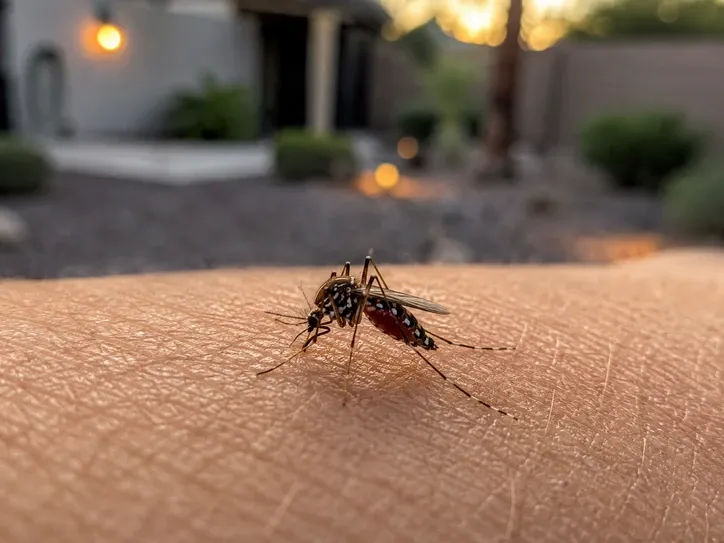
Mosquito Control in Arizona: How to Get Rid of Them in Your Yard
- mosquito control Arizona
Key Takeaways
- Mosquitoes breed in standing water, even a bottle cap’s worth, so eliminating water is the single most effective control, per the CDC.
- Monsoon season supercharges mosquitoes, and the disease risk is real: Arizona reported 63 West Nile virus cases in 2025, with 53 in Maricopa County plus a death, according to state and county health reporting.
- Maricopa County takes it seriously enough to set roughly 850 surveillance traps every week.
- A weekly “tip and toss” of standing water, plus screening water features and treating what you can’t drain, does most of the work.
- EPA-registered repellents (DEET, picaridin) work; bug zappers largely don’t.
If mosquitoes have taken over your yard, the fix isn’t a gadget — it’s water. Mosquitoes can’t breed without it, so the fastest way to fewer bites is finding and eliminating the standing water on your property. Here’s when they peak in Arizona, why they matter, and exactly how to get rid of them.
When is mosquito season in Arizona?
Mosquitoes are active across Arizona’s warm months and explode during monsoon. The summer storms bring the rain that mosquitoes need — the CDC notes mosquitoes lay eggs in standing water, and monsoon downpours leave exactly that in low spots, pool covers, and clogged drains across the Valley.
Timing your defenses matters. Some Arizona mosquito species bite during the day, others at dawn, dusk, and night — and the nighttime biters are the ones most associated with disease transmission. That’s why reducing breeding sites around the home beats trying to avoid bites by the clock.
Are Arizona mosquitoes dangerous?
They can be. Most people bitten never get sick, but West Nile virus is a genuine, local risk. In 2025, Arizona reported 63 West Nile virus cases, with 53 in Maricopa County and at least one death, according to Arizona Department of Health Services and Maricopa County reporting. Maricopa County has ranked among the hardest-hit areas in the nation in bad years.
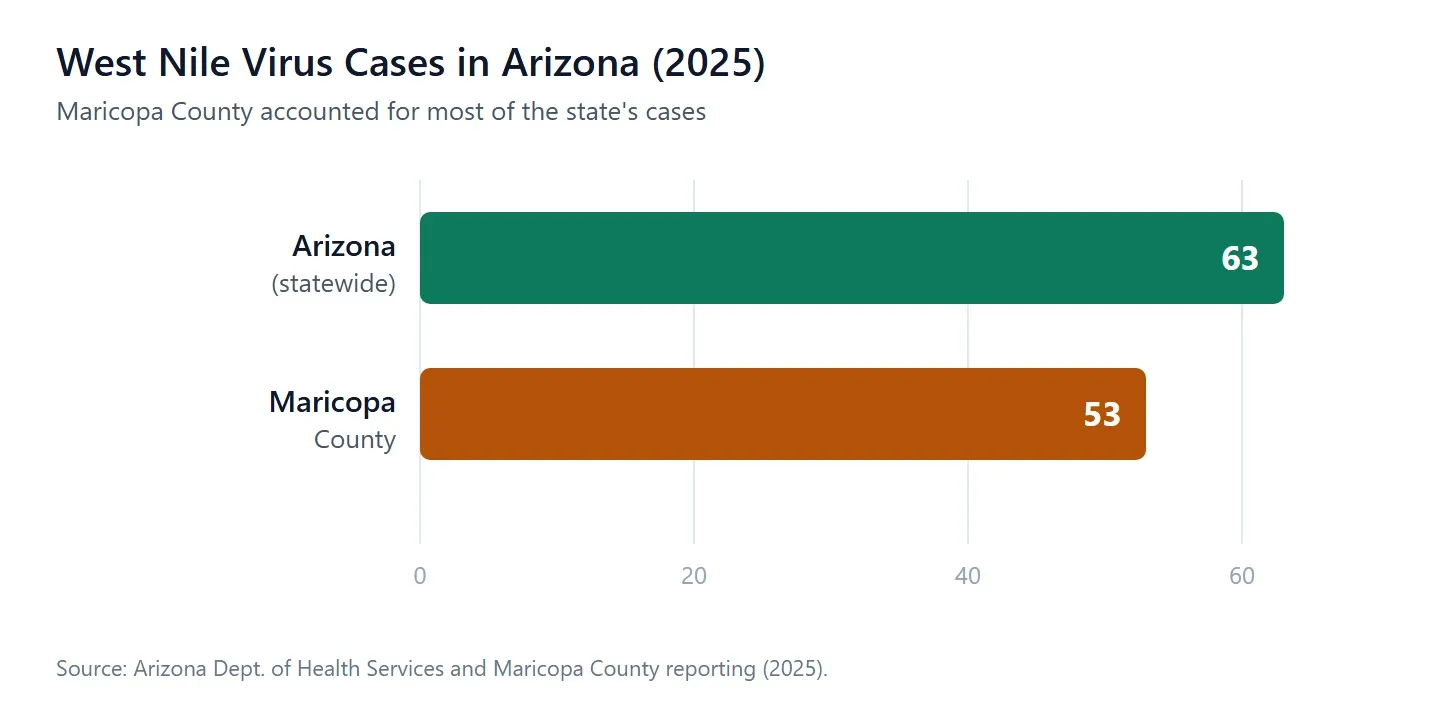
In 2025, Arizona reported 63 West Nile virus cases, 53 of them in Maricopa County.
Most West Nile infections are mild or symptom-free, but a small share become serious, especially for older adults. That’s the case for keeping mosquito numbers down around your home rather than shrugging them off as a nuisance.
How seriously does the county take mosquitoes?
Seriously enough to run one of the largest surveillance operations in the country. Maricopa County’s Vector Control division sets out roughly 850 mosquito surveillance traps every week across the Valley and tests them for viruses, a scale that tells you how established mosquitoes are here.
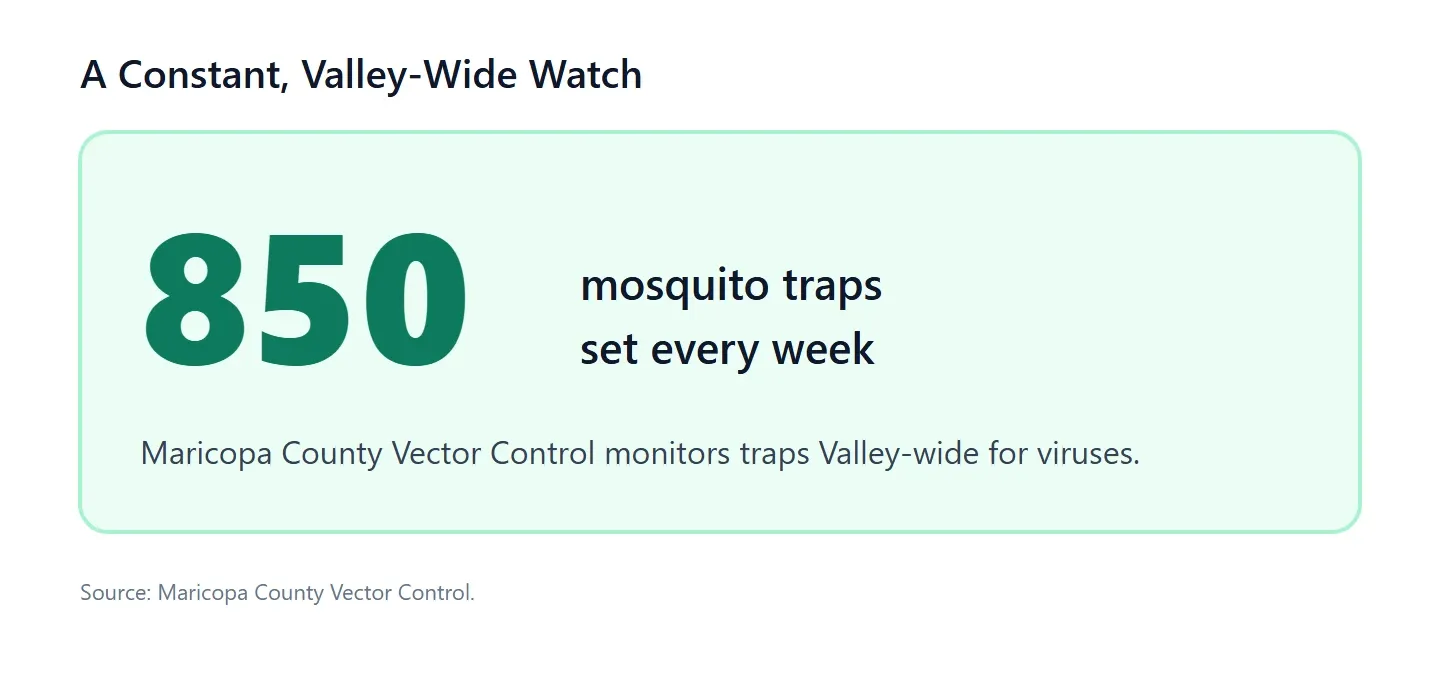
Maricopa County sets roughly 850 mosquito surveillance traps every week.
County programs treat public water sources and washes, but they can’t touch the breeding sites in your own backyard, and that’s where most of the mosquitoes biting you are born.
What attracts mosquitoes to your yard?
Standing water, full stop. It takes shockingly little, the CDC points out that even a bottle cap of water can breed mosquitoes. The usual suspects in a West Valley yard:
- Plant saucers, buckets, toys, and tarps that hold rain
- Clogged gutters and roof drains
- Pool covers, unmaintained or “green” pools, and fountains
- Irrigation boxes, low spots, and drainage that pools after monsoon
- Pet water bowls and birdbaths left to sit
- Overwatering that keeps soil and mulch soggy
Shade and dense vegetation give adult mosquitoes a cool place to rest during the day, which is why overgrown, over-irrigated yards feel the worst.
How to get rid of mosquitoes in your yard (7 steps)
The strategy is simple: remove the water, then treat what’s left. This weekly routine does most of the work.
- Tip and toss weekly. Walk the yard once a week and dump any standing water — saucers, buckets, toys, tarps, bowls. Eggs hatch fast, so weekly matters.
- Clear gutters and drains. Keep roof gutters and yard drains flowing so water doesn’t pool.
- Fix drainage and low spots. Regrade or fill spots that hold water after monsoon storms.
- Maintain pools and water features. Keep pools circulating and chlorinated; never let a pool go green. Empty or treat fountains and birdbaths.
- Screen or treat water you can’t drain. Use larvicide “dunks” (Bti) in rain barrels, ponds, or low areas that stay wet.
- Refresh pet bowls and birdbaths every few days so larvae can’t mature.
- Cut back dense, over-watered vegetation where adult mosquitoes rest, and dial back overwatering.
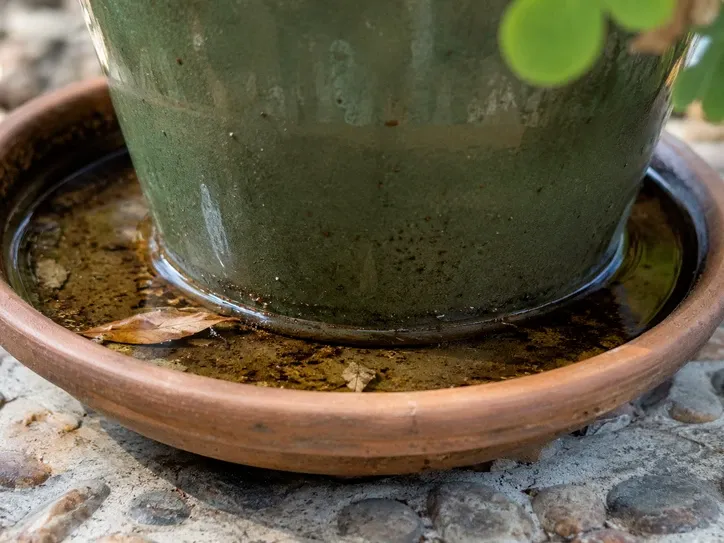
Standing water in a plant saucer, a common backyard mosquito breeding site
Do mosquito repellents and gadgets actually work?
Some do, some are a waste of money. For personal protection, the CDC recommends EPA-registered repellents containing DEET or picaridin, and wearing long sleeves at peak biting times. What doesn’t hold up: most bug zappers (they kill more harmless insects than mosquitoes) and unproven ultrasonic apps and wristbands. Yard treatments that target resting areas and breeding sites are far more effective than any gadget.
Because mosquitoes fly in from neighbors and nearby washes, treating your own breeding sites and resting areas — not just repelling bites, is what actually lowers the population around your home. This is where recurring pest control and monsoon-season yard treatment pay off; see our Arizona monsoon pest control guide for the bigger seasonal picture.
Which mosquitoes live in Arizona?
Arizona has multiple mosquito species, but two groups matter most for homeowners. Culex mosquitoes are the primary carriers of West Nile virus; they’re most active from dusk through the night and breed in stagnant, organically rich water like neglected pools, catch basins, and green standing water. Aedes aegypti, the yellow fever mosquito, is an aggressive daytime biter that has established itself across the Phoenix area. It breeds in small containers of clean water close to homes (saucers, buckets, tires, toys) and is the species public-health agencies watch for dengue and Zika risk.
The practical takeaway: you can’t outsmart them by time of day alone, between the two groups, biting risk spans daytime and night. But they share one weakness, every species needs standing water to breed, so eliminating water sources works against all of them at once.
How can you protect yourself outdoors?
When you can’t avoid peak mosquito times, cut your odds of being bitten:
- Use an EPA-registered repellent with DEET or picaridin, applied per the label — the CDC’s recommended first line of defense.
- Cover up at dawn and dusk with lightweight long sleeves and pants when mosquitoes are most active.
- Run fans on the patio. Mosquitoes are weak fliers, and moving air makes it hard for them to land on you.
- Repair window and door screens so they can’t follow you indoors.
- Skip the gimmicks. Ultrasonic apps, wristbands, and most bug zappers don’t meaningfully reduce bites.
These steps protect you personally, but they don’t shrink the mosquito population, for that, you still have to eliminate breeding sites and treat the areas where adults rest.
When should you call a professional?
Call a pro when standing-water fixes aren’t enough, when you back up to a wash or retention basin, or when you want consistent barrier treatment through monsoon season. A professional targets adult resting areas, treats or eliminates breeding sites, and keeps a barrier in place as mosquitoes fly in from surrounding areas.
At Patrick’s Home Solutions, we’re locally headquartered, licensed and insured (Lic# 9794), and serve the entire West Valley. Mosquito control is exactly the kind of source-and-barrier work we handle through the hottest, wettest part of the year.
Tired of getting eaten alive in your own yard? Call (623) 640-0405 for a free estimate, or request a quote online. We’ll knock down breeding sites and treat the areas mosquitoes rest.
Frequently asked questions
When is mosquito season in Arizona?
Mosquitoes are active through Arizona’s warm months and peak during monsoon, when summer rain leaves the standing water they breed in. Both daytime and nighttime biting species occur here, so reducing backyard breeding sites is more reliable than timing your outdoor activities.
How common is West Nile virus in Arizona?
It’s a real local risk. Arizona reported 63 West Nile virus cases in 2025, including 53 in Maricopa County and at least one death, per state and county health reporting. Most infections are mild, but some become serious, so controlling mosquitoes matters.
What’s the fastest way to reduce mosquitoes in my yard?
Eliminate standing water. Mosquitoes can breed in as little as a bottle cap of water, so a weekly “tip and toss” of saucers, buckets, gutters, and pet bowls, plus fixing drainage, removes the source and cuts the population fast.
Do bug zappers get rid of mosquitoes?
Not really. Bug zappers kill mostly harmless insects and few mosquitoes. The CDC recommends EPA-registered repellents with DEET or picaridin for bites, while eliminating standing water and treating resting areas does the real population control.
What repellent works best against mosquitoes?
The CDC recommends EPA-registered repellents containing DEET or picaridin, applied per label directions, along with long sleeves at dawn and dusk. These are proven far more effective than ultrasonic gadgets or wristbands.
Sources
- U.S. Centers for Disease Control and Prevention, “Mosquitoes” (prevention, breeding, repellents) — https://www.cdc.gov/mosquitoes/ (retrieved 2026-07-08)
- Arizona Department of Health Services, “West Nile Virus” https://www.azdhs.gov/preparedness/epidemiology-disease-control/mosquito-borne/west-nile-virus/index.php (retrieved 2026-07-08)
- Maricopa County, “Mosquito-Borne Disease Surveillance / Vector Control” https://www.maricopa.gov/2476/Mosquito-Borne-Disease-Statistics (retrieved 2026-07-08)
- Arizona Department of Agriculture, “West Nile” https://agriculture.az.gov/pestspest-control/human-diseases/west-nile (retrieved 2026-07-08)
This article is for general educational purposes and is not medical advice. If you develop severe symptoms after mosquito bites, contact a healthcare provider. For current West Nile virus data, see Arizona Department of Health Services and Maricopa County.
About the author

Patrick Hagan
Owner, Patrick's Home Solutions
Patrick Hagan is the owner of Patrick's Home Solutions, a licensed and insured pest, wildlife, weed, and pigeon control company (AZ Lic# 9794) serving the Phoenix West Valley since 2016. The team specializes in identification-first, exclusion-based pest control that keeps cockroaches, scorpions, rodents, and other pests out of West Valley homes.
Read Patrick's storyReady for a Pest-Free Home?
Don't wait for pests to become a bigger problem. Contact Patrick's Home Solutions today for fast, reliable service across the Phoenix Valley.