Do Scorpion Repellents Work? DIY Options vs Professional Scorpion Control
On their own, scorpion repellents rarely end a scorpion problem, and that matters in the West Valley, where scorpions are among the pests homes mostly deal with. If you live in Surprise or nearby and are choosing between a store product and a professional visit, this article compares the two, including the point to call someone and what drives the cost of each.
Key Takeaways
Count on a repellent only to discourage scorpions where it lands; the ones already sheltering in your walls and yard stay put.
Before buying a spray or granule, confirm scorpions are named on the label, because an ant or roach listing says nothing about them.
Bark scorpions climb walls and ceilings, so a ground-level band along the foundation leaves their climbing routes open.
Seal the openings and cut the insect supply together; doing only one leaves scorpions either a way in or a reason to try.
Regular sightings in bedrooms or bathrooms, rather than the odd patio visitor, are the signal to bring in a professional.
What can a scorpion repellent do, and where does it fall short?
A scorpion repellent can make a treated surface less inviting, so some scorpions turn away at the spot where it was applied. It cannot remove scorpions already living in your walls or yard. It also does nothing at a gap it never touched.
A repellent made from plant oils or food-grade ingredients may be sold as a minimum risk pesticide. Under the EPA's conditions for minimum risk pesticides, a product limited to listed active ingredients, with inert ingredients drawn from approved classes such as common food commodities and edible oils, does not need to be registered with EPA. In practice, no one at the agency reviewed that label before it reached the shelf. The same EPA page warns that some label wording can suggest a review that never happened.
Treat any repellent as a deterrent, not a fix. If scorpions keep turning up indoors after you have sprayed, the next step is professional scorpion control rather than another bottle. Sealing the entry points, which is what our scorpion home seal does, closes the gaps a spray only coats.
Do store-bought sprays and granules kill scorpions?
Some do, but only when the label names scorpions and the scorpion gets a real dose. Scorpions are arachnids, so a can listing ants or roaches tells you nothing about them. A contact spray can kill the one you hit directly. A residual spray or granule, one that leaves a film meant to keep working after it dries, acts only where a scorpion crosses it. How long that film lasts depends on the active ingredient, sun and watering. Read the target-pest list before you buy.
Why most repellents fail against bark scorpions, and what kills them
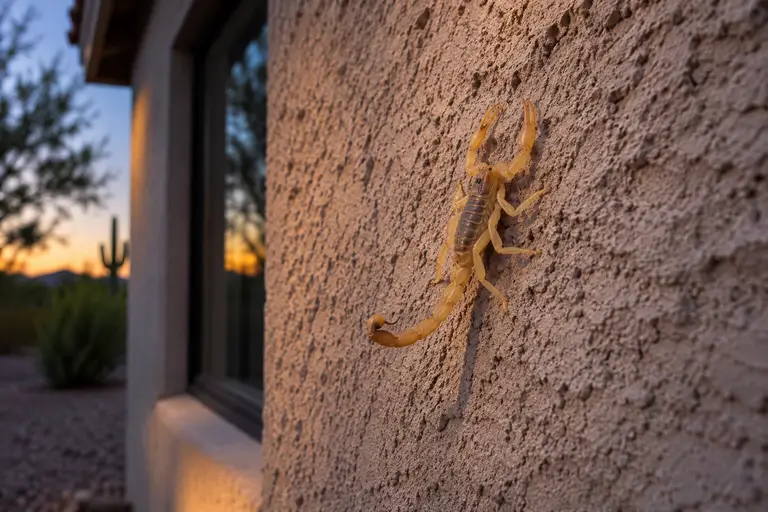
Bark scorpions get past most repellents because they climb. A band sprayed along the foundation or baseboard covers the ground, but these scorpions walk up stucco walls and across ceilings. By day they hide inside cracks and wall voids, out of reach of a surface spray. What kills them is a product labeled for scorpions, placed where they shelter and travel, then renewed before it wears off. Scorpion-proofing your home, closing the gaps they use, keeps new ones from getting in. That matters with this species: CDC/NIOSH's guidance on scorpion stings says symptoms usually subside within 48 hours, although stings from a bark scorpion can be life-threatening. Our guide to scorpion control in Surprise covers bark scorpions in more depth.
How do sealing the house and cutting off their food keep scorpions out?
Sealing takes away the ways in, and cutting off food takes away the reason to come. Scorpions hunt insects. A yard full of prey keeps pulling them toward your walls, where any opening nearby becomes an entrance.
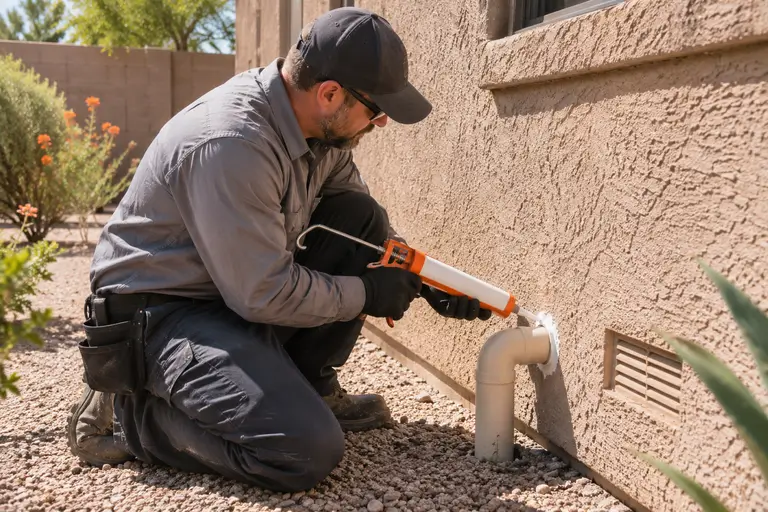
The openings that matter are often small and low on the house: a worn door sweep, a garage door that no longer meets the slab, the spots where pipes and cables pass through the stucco. Weatherstripping and sweeps wear out, so a house that was tight when it was built may not be tight now.
Food is the other half. Crickets are common scorpion prey, which is why cricket control is part of keeping scorpions away. Porch lights left on all night draw insects to the walls, and the scorpions follow them. Our monthly or quarterly pest control is meant to keep that insect supply low through the year, after the first problem is handled. We do not charge to inspect a home for scorpions or for a home seal.
When is it time to call a professional for scorpions?
Call a professional when scorpions are turning up in the parts of the house where people live, rather than now and then on the patio. These are the signs that point there:
You find them in bedrooms or bathrooms. A scorpion in a bed, a shoe or a towel is the one that ends up against bare skin.
You see them on walls or ceilings indoors. A climbing scorpion is moving through the house, not just wandering in under a door.
They show up in more than one room. That points to several ways in, or scorpions already sheltering inside, which a spot spray will not reach.
A small child crawls on your floors. A child at floor level meets a scorpion before an adult notices it, so waiting is harder to justify.
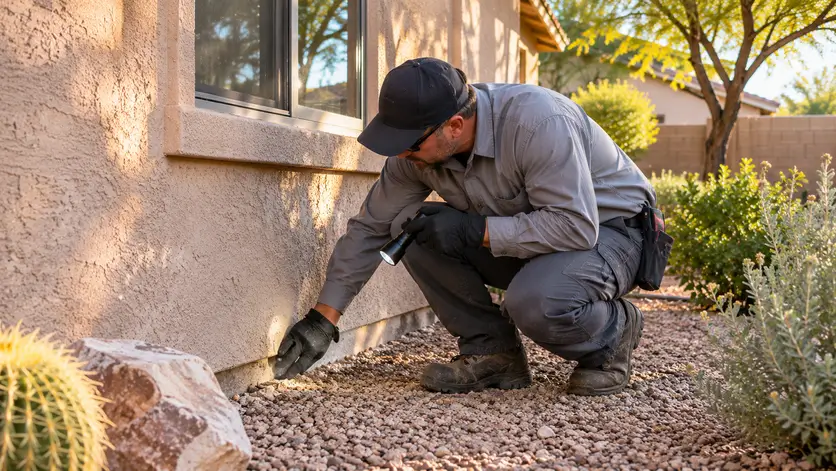
A professional visit should look at the yard as closely as the rooms. The hiding places outside, and the gaps between them and your walls, decide where treatment goes.
Do smells and natural remedies keep scorpions away?
Not reliably. Peppermint and cedar oils are common scents in store products and home remedies meant to ward off scorpions. At best they make one sprayed spot less inviting for a short while. Oils evaporate, and heat speeds that up, so a doorway that smelled strong in the morning may carry almost nothing by the time scorpions come out at night.
Scent is also a weak signal to a hunting scorpion. They find prey mostly by feeling vibrations, so a smell does little to stop one that is following a cricket toward your wall. In the West Valley, the pests we see most are scorpions and crickets, and on new builds those two are the main ones. A scented porch does nothing to separate them.
A natural remedy is not automatically harmless either. Concentrated essential oils can make cats and dogs sick, so a threshold soaked in oil is a risk where pets walk.
What drives the cost of DIY scorpion products vs professional treatment?
A DIY bill grows with every product you buy and every time you buy it again. A professional bill is set by your house and by what the inspection finds, so neither comes with one fixed number.
Cost driver | DIY products | Professional treatment |
|---|---|---|
Size of the property | A bigger house and yard take more bottles and bags | A bigger house and yard take more product and time per visit |
Rebuying | You pay again each time a residual wears off | Repeat visits are set out in the treatment plan |
Reach | Only the spots you can see and get to | Inside and outside, including where scorpions hide |
Sealing gaps | Caulk and door sweeps you buy and fit yourself | Done as our scorpion home seal |
We give the cost of services over the phone, then inspect the home and talk with you before recommending a treatment plan. The National Pest Management Association's scorpion guide says that if you suspect an infestation, the best course is a licensed pest control professional; Patrick's Home Solutions holds Arizona license #9794. For a price on your home, get in touch with us or call 623-640-0405.
Sources
Conditions for Minimum Risk Pesticides | US EPA, U.S. Environmental Protection Agency, retrieved 2026-10-13.
Insects and Scorpions at Work | Outdoor | CDC, CDC/NIOSH, retrieved 2026-10-13.
Scorpions: Facts About Scorpion Bites, Scorpion Control, National Pest Management Association (NPMA), retrieved 2026-10-13.
About the author

Patrick Hagan
Owner, Patrick's Home Solutions
Patrick Hagan is the owner of Patrick's Home Solutions, a licensed and insured pest, wildlife, weed, and pigeon control company (AZ Lic# 9794) serving the Phoenix West Valley since 2016. The team specializes in identification-first, exclusion-based pest control that keeps cockroaches, scorpions, rodents, and other pests out of West Valley homes.
Read Patrick's storyReady for a Pest-Free Home?
Don't wait for pests to become a bigger problem. Contact Patrick's Home Solutions today for fast, reliable service across the Phoenix Valley.