Bats in Your Attic? Arizona Bat Removal & Exclusion Guide
Key Takeaways
- In Arizona, bat exclusion is only legal from October 1 to May 1 - never during maternity season (May-September), per Arizona Game & Fish Department.
- Bats can squeeze through a gap as small as 3/8 inch, so they slip into attics near tile roofs, vents, and soffits.
- Bat guano can carry the fungus that causes histoplasmosis - a lung infection from inhaling spores in disturbed droppings - so cleanup needs proper protection.
- Bats are protected and beneficial (they eat huge numbers of insects); the goal is humane, legal exclusion, not extermination.
- If it’s summer, you can’t exclude yet - but you can plan now for a fall exclusion.
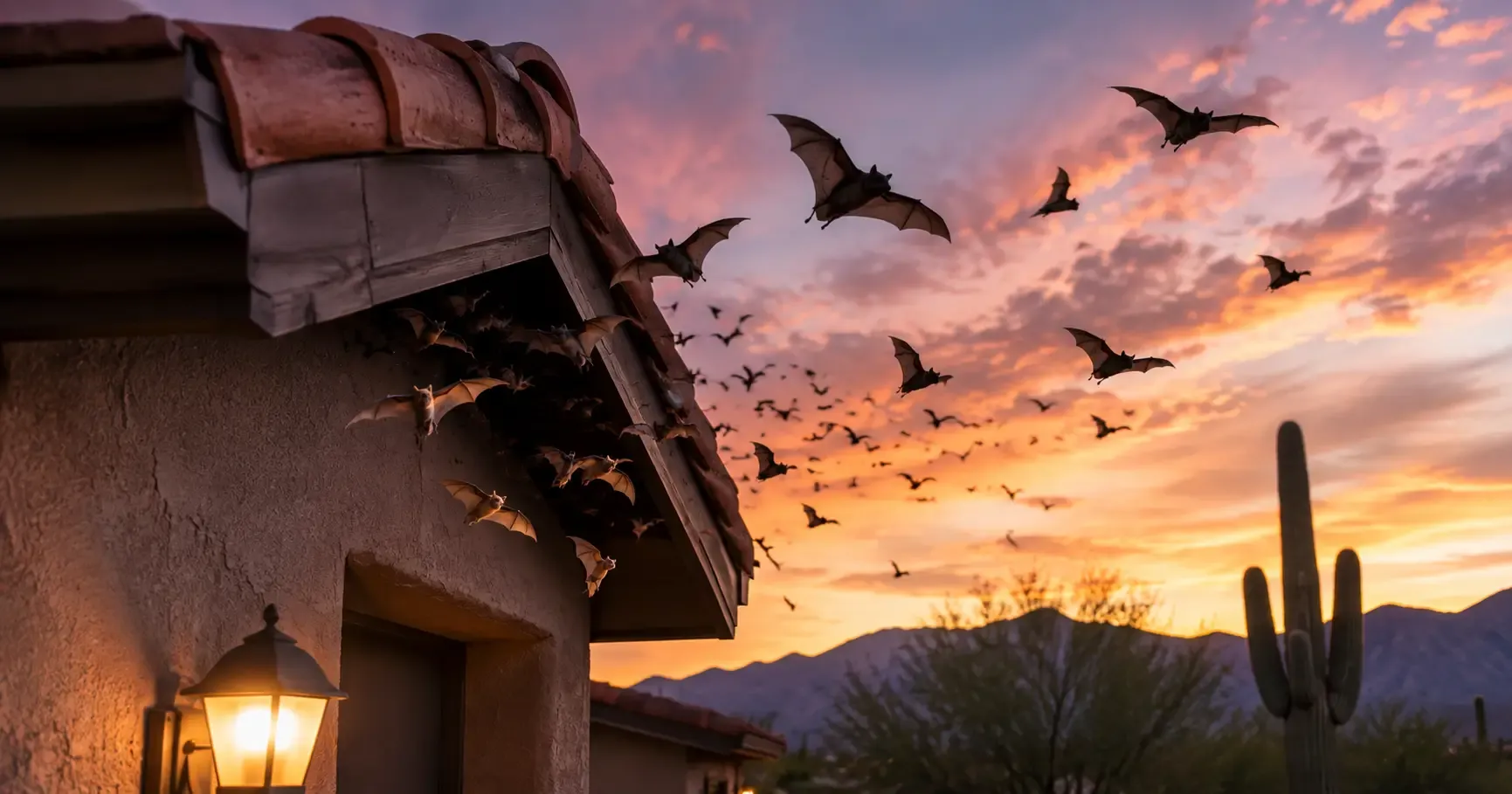
Hearing scratching overhead at dusk, or seeing bats stream out from under the tile at sunset, tells you one thing: you likely have a roost. But in Arizona, you can’t just seal it up whenever you want. Bats are protected, and the timing is strict. Here’s how bat removal actually works - legally, safely, and for good.
How do bats get into your attic?
Bats don’t chew their way in; they exploit gaps that already exist. Arizona Game & Fish notes bats can enter openings as small as 3/8 inch, which means the small gaps common on Valley homes are wide-open doors. Typical entry points include gaps near tile roofs, under soffits and fascia, around vents and chimneys, and where different rooflines meet.
You’ll usually notice them at dusk, when bats leave the roost to feed, or by the signs they leave behind: scratching or squeaking sounds, a musty ammonia smell, dark greasy staining at an entry point, and droppings (guano) accumulating below.

How can you tell it’s bats - not birds or rodents?
A few signs separate bats from other attic intruders. Bats are most active at dusk, when you’ll see them stream out from a single spot to feed and return before dawn - birds come and go during daylight, and rodents tend to scurry inside the walls at night. Bat droppings (guano) collect in concentrated piles directly below the roost, often glitter with shiny insect fragments, and crumble to dust - unlike the hard, solid droppings rodents leave. A musty, ammonia-like odor and dark, greasy staining around a small entry point also point to bats.
If you’re seeing daytime roof activity and nesting material instead, you may have birds - see our guide on keeping pigeons off solar panels and rooflines. When in doubt, a professional inspection confirms the species and every entry point before anything gets sealed.
When can you legally remove bats in Arizona?
This is the part that surprises most homeowners: you can only exclude bats between October 1 and May 1. Arizona Game & Fish prohibits exclusion during the maternity season (generally May through September), because that’s when females are raising flightless pups. Sealing the roost then would trap and kill the young - and leave you with a far worse odor and cleanup problem.

So if you’re reading this in summer, the answer is: not yet. The right move now is to document the entry points and get on the schedule for a fall exclusion - the moment the window opens on October 1.
Is bat guano dangerous?
It can be. Bat droppings can harbor the fungus behind histoplasmosis, a lung infection the CDC describes as caused by inhaling airborne spores from dust enriched with bird or bat droppings. Disturbing a guano pile - sweeping, vacuuming, or demolishing insulation - can send spores into the air. Beyond disease risk, accumulated guano causes strong odor, stains, and can damage insulation and drywall.

That’s why guano cleanup isn’t a casual DIY job. It calls for proper protective equipment (gloves, respirator, eye protection) and careful containment - the kind of remediation a professional handles as part of the exclusion.
How does professional bat exclusion work?
Done right, exclusion is humane and permanent. Within the legal window, the process looks like this:
- Inspection. Find every entry point and confirm the roost and species.
- One-way exclusion. Install one-way devices that let bats leave to feed but not return - no trapping, no harm.
- Wait, then seal. Once all bats are out, seal every gap 3/8 inch and larger so they can’t re-enter. This is the same home sealing discipline applied to the whole roofline.
- Guano remediation. Safely remove droppings and disinfect, with proper protection.
The sealing step is what makes it stick. Evict the bats without closing the gaps, and a new colony simply moves back in.
What should you do during maternity season (now)?
If it’s May through September, you’re in the blackout - but you’re not helpless:
- Don’t seal the entry points. Trapping pups inside creates a worse problem.
- Document the roost. Note where bats exit at dusk and where guano is collecting.
- Keep the area undisturbed. Avoid stirring up guano without protection.
- Get on the fall schedule. Book the exclusion so it happens as soon as the window opens October 1.
- Contain exposure indoors. Keep attic access closed and living spaces separated from the roost.
Why hire a licensed professional?
Bat work is legally regulated and genuinely hazardous, so it’s not a DIY project. A qualified company works within the legal window, uses humane one-way exclusion, handles guano remediation safely, and seals the home so bats can’t return. Doing it yourself risks harming a protected species, breaking the maternity-season rule, and exposing your household to guano.
At Patrick’s Home Solutions, we’re locally headquartered, licensed and insured (Lic# 9794), and serve the entire West Valley. Bat exclusion is exactly the kind of seal-it-out wildlife exclusion work we specialize in - and the same care we bring to droppings cleanup, as covered in our pigeon droppings health guide.
Bats in your attic? Call (623) 640-0405 for a free estimate, or request a quote online. We’ll inspect now and schedule a safe, legal exclusion the moment the window opens.
Frequently asked questions
Is it legal to remove bats in Arizona?
Yes, but only within a set window. Arizona Game & Fish allows bat exclusion from October 1 to May 1 and prohibits it during maternity season (May-September) to protect flightless pups. Bats are a protected, beneficial species, so exclusion must be humane.
When is the best time for bat exclusion?
Between October 1 and May 1, once the maternity season ends. Fall (right after October 1) is popular because the pups can fly and the colony can be excluded and sealed out before the next breeding season begins.
Is bat guano dangerous to health?
It can be. Guano can harbor the fungus that causes histoplasmosis, a lung infection from inhaling spores in disturbed droppings. Cleanup requires protective equipment and careful containment, which is why professional remediation is recommended over DIY.
How do bats get into an attic?
Through existing gaps as small as 3/8 inch - commonly near tile roofs, soffits, fascia, vents, and chimneys. Bats don’t gnaw their way in; sealing these openings (after the bats are out) is what keeps them from returning.
Will bats leave the attic on their own?
Not reliably, and not permanently. They return to established roosts year after year. Professional one-way exclusion during the legal window, followed by sealing every entry point, is the only dependable way to get them out for good.
Sources
- Arizona Game & Fish Department, “Living with Bats” - https://www.azgfd.com/wildlife-conservation/living-with-wildlife/living-with-bats/ (retrieved 2026-08-05)
- U.S. Centers for Disease Control and Prevention, “Histoplasmosis” - https://www.cdc.gov/histoplasmosis/about/index.html (retrieved 2026-08-05)
- Axios Phoenix, “Arizona officials say not to remove attic bats during the summer” (2024) - https://www.axios.com/local/phoenix/2024/04/09/bat-removal-arizona-summer (retrieved 2026-08-05)
About the author: Patrick Hagan is the owner of Patrick’s Home Solutions, a licensed and insured pest, wildlife, weed, and pigeon control company (AZ Lic# 9794) serving the Phoenix West Valley since 2016. The team specializes in humane, legal wildlife exclusion that seals bats, birds, and other wildlife out of West Valley homes for good.
Ready for a Pest-Free Home?
Don't wait for pests to become a bigger problem. Contact Patrick's Home Solutions today for fast, reliable service across the Phoenix Valley.