How to Keep Pigeons Off Solar Panels in Arizona
How to Keep Pigeons Off Solar Panels in Arizona
By Patrick Hagan — Licensed Pest Control Operator, AZ ODA License #9794
Arizona installs more rooftop solar than almost any other state — and every one of those arrays is a five-star hotel for pigeons. The state ranks 4th in the nation for solar, with enough installed to power over 1.7 million homes (SEIA, 2025). That's a lot of warm, shaded real estate sitting on Phoenix Valley rooftops.
If you've spotted birds ducking under your panels or heard cooing on the roof at dawn, you already have a problem starting. Here's why pigeons love your solar array, what the damage actually costs you, and how to stop them without voiding your warranty.

Key Takeaways
- Pigeons nest under panels for the shade and predator protection, especially in 110°F-plus summers.
- Droppings are acidic and corrode wiring; debris and soiling can cut output by 10–20% or more (industry estimates, 2025).
- Perimeter exclusion mesh is the proven fix — spikes and gels alone usually fail in Arizona.
- Clip-mounted systems protect panels without drilling, avoiding warranty issues.
Why Do Pigeons Nest Under Solar Panels in Arizona?
Pigeons nest under solar panels because the gap underneath is the best shelter on the roof: shaded, predator-safe, and a few degrees cooler than the open desert sun. With Phoenix summer highs regularly topping 110°F, and rooftop surfaces running far hotter, that pocket of shade becomes prime real estate.
Think about it from a bird's point of view. The roughly 18-inch space between your panels and the roof deck is dry, hidden from hawks, and warm in winter. In a climate this harsh, that combination is rare. Pigeons grab it and don't let go.
It gets worse, because pigeons are creatures of habit. They return to the same roost generation after generation, and in Arizona's mild climate they breed for most of the year rather than one short season. Remove a nest and ignore the gap, and a new clutch shows up within weeks.
Do Pigeons Actually Damage Solar Panels?
Yes — and the damage is both electrical and financial. Pigeon droppings are acidic and slowly corrode aluminum frames, wiring insulation, and the roof underlayment beneath the array, while accumulated nests and debris shade cells and trap heat. Industry estimates put the output loss from soiling and shading at 10–20% or more on affected systems (industry estimates, 2025).
Treat that range as an industry estimate, not a lab measurement, but the direction is clear: panels caked with droppings and shaded by nests generate less power, and the loss compounds the longer it goes unaddressed. Over a full year of reduced production, that's real money off your utility savings.

Source: industry estimates, 2025.
There's a safety angle too. The dry twigs, feathers, and grass pigeons drag under panels are flammable, and they sit right next to wiring and connectors that generate heat. Chewed or corroded wires plus combustible nesting material is a fire risk nobody wants on their roof. The droppings are also a health hazard once they dry out and turn to dust — more on that in our guide to cleaning pigeon droppings safely.
How Do You Pigeon-Proof Solar Panels? (4 Methods Ranked)
The single most effective method is perimeter exclusion mesh that seals the gap around the entire array. Everything else — spikes, gels, decoys — either fails outright in Arizona or only works as a supplement. Here's how the common options stack up.
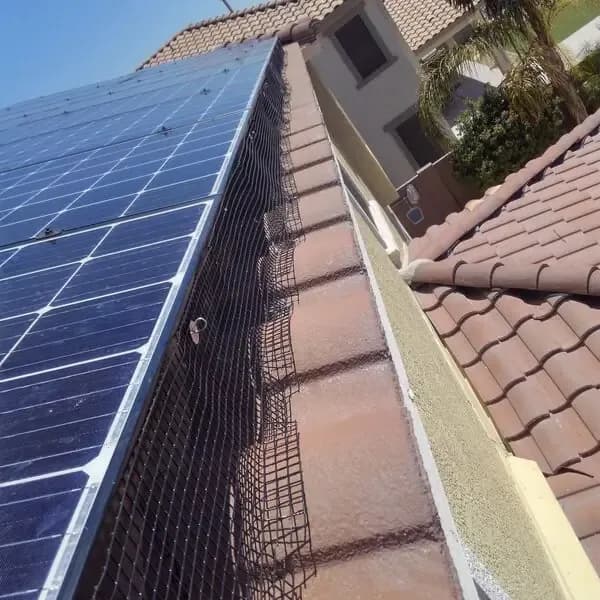
1. Perimeter exclusion mesh (best). A galvanized or PVC-coated wire mesh runs around the panel edges and clips to the frame, closing off the under-panel gap entirely. Birds can't get in, so they can't nest. Done right, it lasts years and is nearly invisible from the ground.
2. Gap clips and edge guards (good). Specialized clips fasten mesh or guard strips to the panel lip without drilling. This is the warranty-safe backbone of most professional installs and pairs with full perimeter mesh.
3. Spikes (limited). Spikes stop birds from landing on a surface, but Arizona pigeons nest under the panels, not on top. Spikes on the roofline help a little; they don't solve the core problem.
4. Gels, decoys, and sound devices (weakest). Visual and scent deterrents fade fast in the desert sun and heat, and pigeons quickly learn that a plastic owl never moves. On their own, they're a waste of money.

Relative comparison based on field experience in the Phoenix Valley.
Here's the insight most homeowners miss: the deterrents marketed hardest are the ones that work least in this climate. We've watched gel disks liquefy in July heat and decoys bleach white by August. The boring solution, sealing the gap with mesh, is the one that actually holds.
Does Bird-Proofing Void My Solar Warranty?
It can, if it's done carelessly. Drilling into panels or penetrating the roof to anchor mesh can void both your panel manufacturer's warranty and your roof warranty. That's why method matters as much as materials.
Clip-based systems sidestep the problem by fastening to the existing panel frame — no new holes in the glass, the backsheet, or the roof membrane. Before any work starts, check your panel manufacturer's documentation for language about third-party attachments, and use an installer who understands solar mounting, not just bird removal.
Should You DIY It or Hire a Pro?
For most Arizona homeowners, this is a professional job. You're working on a hot, often two-story roof, around live electrical equipment, and you'll disturb dried droppings that carry real health risks when they go airborne.
On a typical West Valley install, our crew finds the first nest within about 30 days of pigeons claiming an array — and where there's one nest, there's usually droppings buildup that needs proper cleanup and sanitizing before exclusion goes on. Doing it once, correctly, beats climbing back up every few months to pull out fresh nests, and it keeps you from disturbing droppings that carry real health risks.
Our professional pigeon control service handles nest removal, sanitation, and perimeter exclusion as one job, across Phoenix, Peoria, Surprise, and the rest of the West Valley.
How Much Does Solar Pigeon-Proofing Cost in Arizona?
Pricing depends on three things: the size of your array, how many stories your home is, and whether there's existing nesting and droppings to clean first. A single-story home with a small array and no buildup costs far less than a two-story home with years of accumulated nests.
Most quotes bundle three line items: nest removal, cleanup and sanitation, and the exclusion install itself. Because the exclusion is a one-time fix rather than a recurring treatment, it usually pays for itself against the energy you'd otherwise keep losing. The honest way to price it is an on-site look — get a free quote and we'll tell you exactly what your roof needs.
Frequently Asked Questions
Will pigeons leave my solar panels on their own?
Rarely. Pigeons are loyal to a roost and return to the same site year after year, even after a nest is removed. In Arizona they breed nearly year-round, so an unprotected array stays attractive. Physical exclusion is the only reliable way to make them leave for good.
Do pigeons actually damage solar panels?
Yes. Acidic droppings corrode frames, wiring, and roof materials, while nesting debris shades cells and blocks airflow. Industry estimates put output losses from soiling and shading at 10–20% or more on affected systems (industry estimates, 2025).
Does bird-proofing void my solar warranty?
It can if the installer drills into panels or the roof improperly. Clip-based exclusion attaches to the panel frame without penetrating it, which avoids most warranty issues. Confirm the method with a licensed installer and review your manufacturer's terms first.
Does exclusion mesh reduce solar panel efficiency?
No. Properly installed mesh only seals the open gap around and beneath the array. It doesn't cover the panel face or block ventilation. In practice it protects output by keeping droppings and debris off the cells.
When is the best time to pigeon-proof solar panels in Arizona?
Before nesting starts — ideally late winter or early spring. But since pigeons breed almost year-round here, the practical answer is as soon as you notice roosting. Earlier exclusion means less cleanup and less wiring damage.
The Bottom Line
Pigeons under your solar panels aren't just a nuisance — they're quietly shaving money off your energy savings and adding corrosion and fire risk to your roof. The fix isn't a plastic owl or a strip of spikes. It's sealing the gap with proper perimeter exclusion, installed in a way that protects your warranty.
- Pigeons nest under panels for shade and safety; they won't leave on their own.
- Droppings and debris corrode hardware and cut output by 10–20% or more.
- Perimeter mesh works; deterrents alone don't.
- Clip-mounted exclusion avoids drilling and warranty trouble.
Ready to protect your panels and your savings? Call Patrick's Home Solutions at 623-640-0405 for a free solar pigeon-proofing quote.
About the author: Patrick Hagan is a Licensed Pest Control Operator (Arizona Department of Agriculture License #9794) and owner of Patrick's Home Solutions, serving the Phoenix Valley.
Sources
- SEIA, Arizona Solar & Storage, retrieved 2026-06-18, https://seia.org/state-solar-policy/arizona-solar/
Ready for a Pest-Free Home?
Don't wait for pests to become a bigger problem. Contact Patrick's Home Solutions today for fast, reliable service across the Phoenix Valley.