Are Pigeon Droppings Dangerous? Cleanup & Health Risks in AZ
Are Pigeon Droppings Dangerous? Cleanup & Health Risks in AZ
By Patrick Hagan — Licensed Pest Control Operator, AZ ODA License #9794
It's not the mess that makes pigeon droppings dangerous — it's what happens when they dry out. Once dried, droppings turn brittle and crumble into fine dust at the slightest disturbance, and that dust can carry fungal spores deep into your lungs (NYC Health, 2025).
So before you grab a broom and start sweeping that balcony, attic corner, or buildup under your solar panels, read this. Knowing which diseases are actually in play — and the one rule that prevents most exposure — changes how you should clean it.
Key Takeaways
- The real danger is inhaling airborne spores from dried droppings, not casual contact.
- Key diseases include histoplasmosis, cryptococcosis, and psittacosis (CDC, 2025).
- Never dry-sweep: wet the area first and wear an N95 respirator and gloves.
- Large or old buildups — and anyone immunocompromised — call for professional cleanup plus bird exclusion.
Medical note: This article is general information, not medical advice. If you develop fever, cough, or chest pain after exposure to bird droppings, contact a healthcare provider.
Are Pigeon Droppings Actually Dangerous?
Yes, but the risk comes from a specific path: inhaling contaminated dust, not touching the droppings. Dried droppings become friable — they crumble into fine particles that go airborne with a footstep, a gust of wind, or a careless sweep — and those particles can carry fungal spores and bacteria (NYC Health, 2025).
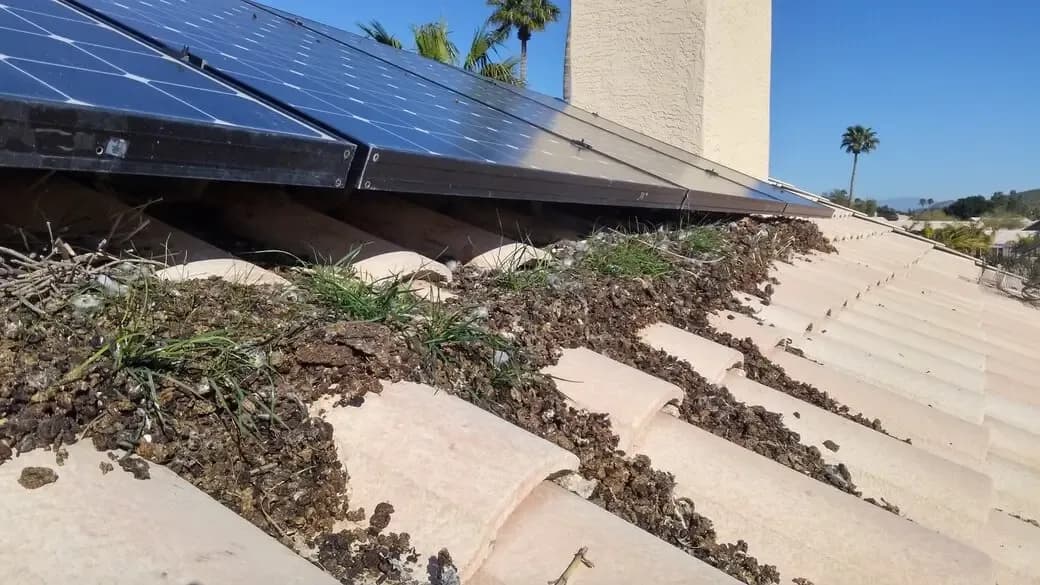
That single fact drives everything about safe cleanup. A fresh, wet dropping on your patio is a minor cleanup. A dried crust that's been baking under your solar panels for two summers is a different situation entirely, because disturbing it launches a cloud of spores right into your breathing zone.
Arizona's climate makes this worse, not better. Our extreme dryness and heat desiccate droppings quickly, so they reach that brittle, easily-airborne state faster than they would in a humid climate.
What Diseases Come From Pigeon Droppings?
Three diseases come up again and again: histoplasmosis, cryptococcosis, and psittacosis. The first two are fungal infections tied to material enriched by bird droppings; the third is bacterial. All three are mainly contracted by breathing in contaminated dust or aerosols.
Histoplasmosis is caused by a fungus that spreads in bird and bat droppings that mix into soil. Most cases are mild or symptom-free, but it can cause fever, cough, fatigue, and chest pain, and symptoms usually appear 3 to 17 days after breathing in the fungus (CDC, 2025).
Cryptococcosis comes from a fungus associated with pigeon droppings. It usually starts in the lungs but can spread to the brain and cause cryptococcal meningitis — a serious infection that carries significant mortality even with treatment (CDC, 2025).
Psittacosis is caused by the bacterium Chlamydia psittaci. People catch it by breathing in dust from dried droppings or respiratory secretions of infected birds, and it can progress to pneumonia requiring hospitalization (CDC, 2025).

Highest risk: children, elderly, pregnant, and immunocompromised people. Source: CDC and NYC Health, 2025.
Who Is Most at Risk?
The greatest danger falls on people with weakened or developing immune systems. Children, the elderly, pregnant women, and the immunocompromised — including people with HIV/AIDS, organ-transplant recipients, and patients undergoing chemotherapy — face the highest risk of serious illness from these infections (CDC, 2025).
For a healthy adult, a brief, low-level exposure often causes mild symptoms or none at all. But that's exactly why people underestimate the hazard. If anyone in a vulnerable group lives in the home, even a moderate droppings buildup deserves professional handling.
How Do You Clean Pigeon Droppings Safely?
The golden rule is simple: never dry-sweep droppings — wet them first and protect your lungs. Dry sweeping or scraping is the single most common way people aerosolize spores and expose themselves. Here's the safe sequence for a manageable cleanup:
- Ventilate and clear the area. Keep children, pets, and at-risk people away while you work.
- Gear up. Wear a NIOSH-approved N95 (or better) respirator, gloves, eye protection, and disposable coveralls.
- Wet it down. Mist the droppings with water or a disinfectant solution and let them soak so they don't turn to dust.
- Remove gently. Scrape the softened material into sealable plastic bags — no dry brushing.
- Disinfect the surface. Clean with an appropriate disinfectant after the bulk is removed.
- Dispose and decontaminate. Seal the bags, then carefully remove and launder or discard your PPE.
Notice that every step exists to stop one thing: dust going airborne. That's the whole game. Once you understand the spores are the hazard, the "wet, don't sweep" method makes complete sense — and it's why hardware-store dust masks aren't enough for big jobs. For buildups under solar arrays, the cleanup pairs naturally with bird-proofing; see our guide to keeping pigeons off solar panels.
When Should You Call a Professional?
Call a pro for any large, old, or hard-to-reach buildup — attics, HVAC systems, wall cavities, or compacted droppings under solar panels. These jobs involve more material, more confined dust, and higher exposure than a quick patio wipe-down.
It's also the right call any time someone in the household is in a high-risk group. A professional brings proper respiratory protection, containment, sanitation, and safe disposal, and can pair the cleanup with the step that actually ends the problem. Our pigeon control service handles removal, sanitation, and exclusion together across Phoenix and the West Valley.

How Do You Prevent Droppings From Coming Back?
The only way to permanently stop droppings is to remove the roost. As long as pigeons perch and nest on your roof, ledges, or solar array, the droppings keep coming no matter how often you clean.
Exclusion — netting, mesh, spikes, and solar-panel guards — denies birds the landing and nesting spots they want, which breaks the cycle at its source. Cleanup plus exclusion is the combination that keeps the area clean for good rather than for a week. Get a free quote and we'll handle both in one visit.
Frequently Asked Questions
Can you get sick from breathing pigeon droppings?
Yes. When dried droppings are disturbed, they crumble into fine dust that can carry fungal spores and bacteria into the air. Inhaling that dust is the main route for diseases like histoplasmosis and cryptococcosis, which is why droppings should never be swept or scraped dry.
Is it safe to clean pigeon droppings myself?
Small, fresh messes are manageable with gloves, an N95 respirator, and wet cleaning. But large, dried, or long-standing buildups — especially in attics, HVAC systems, or under solar panels — are best left to professionals, particularly if anyone in the home is immunocompromised.
What diseases come from pigeon droppings?
The three most cited are histoplasmosis and cryptococcosis (fungal lung infections that can spread further) and psittacosis (a bacterial infection that can cause pneumonia). The greatest risk is to people with weakened immune systems (CDC, 2025).
Do I need a respirator to clean bird droppings?
Yes, for anything beyond a tiny fresh spot. A NIOSH-approved N95 or better filters the fine, spore-laden dust dried droppings release. Pair it with gloves and eye protection, and wet the material first so fewer particles go airborne.
Are pigeon droppings under my solar panels a health risk?
They can be. Droppings that accumulate under panels dry in Arizona's heat and go airborne during cleaning or maintenance. The safest approach is professional cleanup and sanitation followed by bird exclusion so droppings stop building up.
The Bottom Line
Pigeon droppings are a genuine health hazard, but the danger is specific and preventable. The spores ride on airborne dust from dried droppings, so the safe move is always to wet first, protect your lungs, and never dry-sweep — then remove the roost so it doesn't happen again.
- Dried droppings + disturbance = airborne spores.
- Histoplasmosis, cryptococcosis, and psittacosis are the main concerns.
- Vulnerable household members raise the stakes considerably.
- Cleanup plus exclusion is the only lasting fix.
Dealing with a droppings buildup you'd rather not breathe in? Call Patrick's Home Solutions at 623-640-0405 for professional cleanup and bird-proofing.
About the author: Patrick Hagan is a Licensed Pest Control Operator (Arizona Department of Agriculture License #9794) and owner of Patrick's Home Solutions, serving the Phoenix Valley.
Sources
- Centers for Disease Control and Prevention, About Histoplasmosis, retrieved 2026-06-18, https://www.cdc.gov/histoplasmosis/about/index.html
- Centers for Disease Control and Prevention, Clinical Overview of Cryptococcosis, retrieved 2026-06-18, https://www.cdc.gov/cryptococcosis/hcp/clinical-overview/index.html
- Centers for Disease Control and Prevention (NIOSH), Histoplasmosis: Related Infectious Disease Risks for Workers (psittacosis), retrieved 2026-06-18, https://www.cdc.gov/niosh/histoplasmosis/related-risks/index.html
- NYC Health, Pigeon-Related Diseases, retrieved 2026-06-18, https://www.nyc.gov/site/doh/health/health-topics/pigeon.page
Related Articles
Ready for a Pest-Free Home?
Don't wait for pests to become a bigger problem. Contact Patrick's Home Solutions today for fast, reliable service across the Phoenix Valley.