
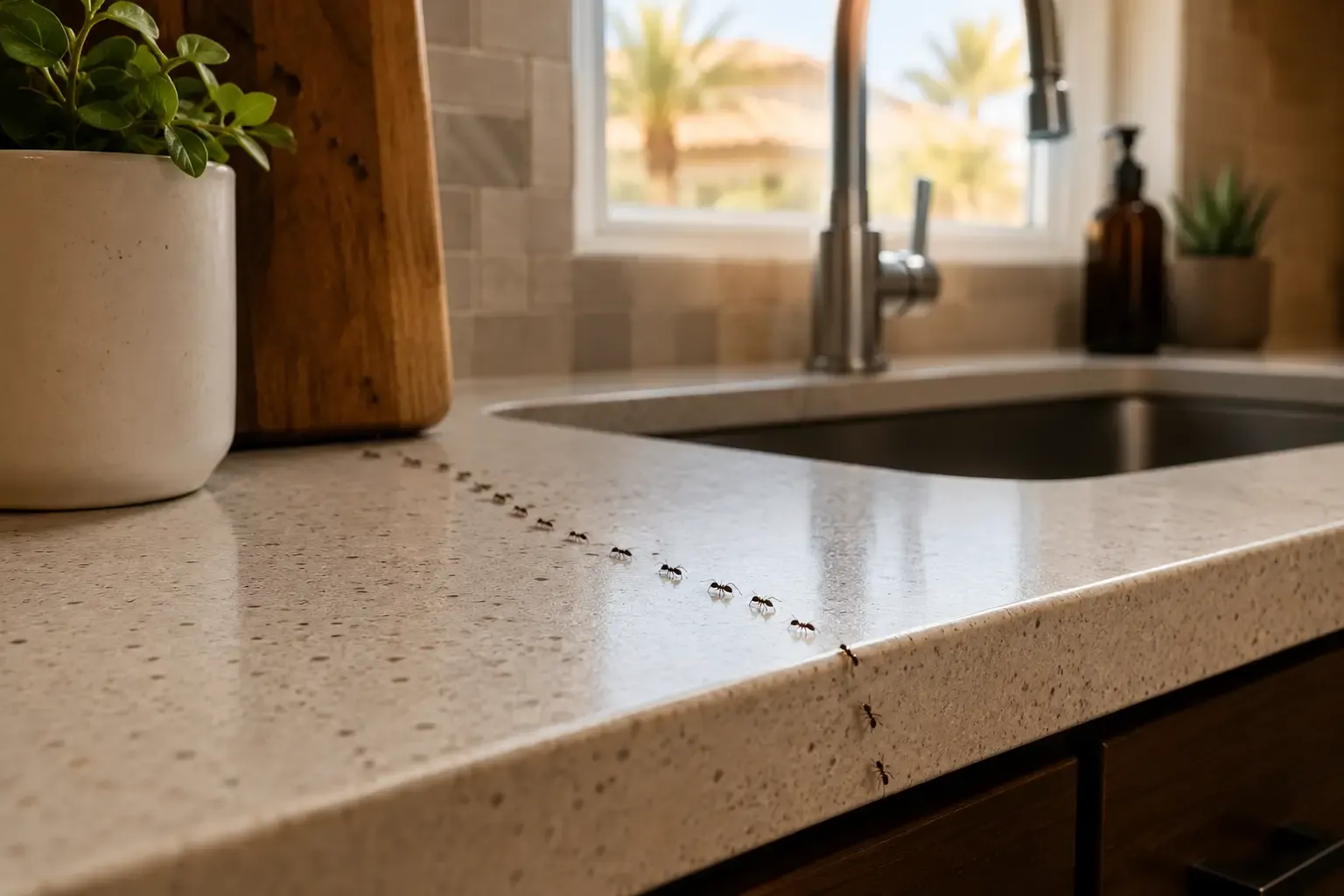
How to Get Rid of Ants in Arizona (and Keep Them Out)
Key Takeaways
- Arizona’s common home-invading ants include the odorous house ant, Argentine ant, carpenter ant, and harvester ant, per University of Arizona Cooperative Extension.
- Odorous house ants “often invade a home by the thousands following a change in the weather” - which is why you see sudden trails after a monsoon storm.
- Ants come indoors for food and water, so sanitation, sealing entry points, and targeted baits are the real fix.
- Carpenter ants can damage wood; harvester ants build cleared mounds in yards; most others are nuisances.
Ants are the pest almost every Arizona homeowner deals with eventually - a line of them across the counter after a storm, or a mound erupting in the gravel. The trick is knowing which ant you have, because the wrong approach (usually reaching for spray) can actually make the problem worse. Here’s how to identify Arizona’s common ants and get rid of them for good.
What kinds of ants live in Arizona?
Arizona homes and yards see several ant species, and University of Arizona Cooperative Extension highlights a handful that matter most. The odorous house ant is a tiny (1/8” to 1/4”) blackish-brown ant that, in Extension’s words, “often invade a home by the thousands following a change in the weather” and gives off “a distinct smell when crushed.” The Argentine ant forms huge colonies with many queens, often nesting under flagstone. The carpenter ant is large (1/4” to 1/2”), nests in wood, and leaves “sawdust-like frass outside nests.” The harvester ant builds the familiar desert mound “identified by a clearing of vegetation around an ant hole in the center.”

Common Arizona ants: where they nest and what to watch for (UA Cooperative Extension).
Correctly identifying which one you’re dealing with is the first step - it determines where to treat and what actually works.
How do you know you have an ant problem?
The obvious sign is a trail, but the details tell you which ant it is. Sudden indoor trails “by the thousands” after a weather change point to odorous house ants. Sawdust-like frass (fine wood shavings) near a windowsill, door frame, or baseboard suggests carpenter ants excavating galleries - they’re most active after sunset. Large cleared mounds in the yard with a bare ring around the entrance are harvester ants. Colonies under patio flagstone with countless workers are often Argentine ants.
One quick check: if you crush a small brown ant and it gives off a distinct, unpleasant smell, you’ve likely found the odorous house ant.
Are Arizona ants dangerous?
Most are nuisances, but a couple deserve respect. Carpenter ants don’t eat wood like termites, but they hollow it out to nest, which can mean damage over time in door frames, window frames, and moist wood. Harvester ants are generally “benign in open spaces,” per UA Extension, but they can deliver a painful sting if you disturb a mound - worth keeping kids and pets clear of. The rest, like odorous house and Argentine ants, are mainly a contamination-and-annoyance problem in kitchens and pantries.

A harvester ant mound with a cleared ring of bare soil around the entrance
Why do you keep getting ants?
Ants come inside for two things: food and water. Sugary spills, crumbs, pet food, and moisture from leaks or condensation are all invitations. Scout ants find a source, then lay a scent (pheromone) trail that recruits the rest of the colony - which is why a few ants become a highway overnight. Arizona’s weather swings play a role too: Extension notes odorous house ants pour indoors “following a change in the weather,” so monsoon storms and heat waves often trigger sudden invasions as ants seek shelter, water, or food.
How to get rid of ants in Arizona
The method that works is a sequence, not a single spray. University of Arizona Extension’s approach for household ants breaks down into clear steps:
- Sanitation. Wipe up spills, store food in sealed containers, and clean up crumbs and pet food. Remove the water and food that draw ants in.
- Exclusion. Follow the trail to where ants enter, then seal cracks and caulk seams. This is the same sealing work behind our home sealing service.
- Erase the trail. Scrub trails with detergent to remove the scent (pheromone) trail so followers lose the path.
- Bait - don’t spray over it. Ants carry toxic baits back to the nest, killing the colony at its source. UA Extension is explicit: “If using toxic baits, do not use insecticide sprays; they will not allow effective transport of toxin to the colony.”

The 4-step ant control method: sanitation, sealing, erasing trails, then baiting.
That last point is the one most people get wrong. Spraying the visible ants feels satisfying but kills only the foragers and can scatter some colonies - while a well-placed bait wipes out the nest.
How do you keep ants from coming back?
Prevention is about removing attractants and maintaining a barrier. Keep the kitchen clean, fix leaks and moisture, and store food sealed. Outside, move woodpiles away from the house, trim vegetation touching the walls, and keep an eye on flagstone and irrigation lines where colonies gather. A recurring exterior pest control treatment keeps a fresh barrier in place so new colonies don’t establish a foothold - especially useful during the monsoon surge covered in our monsoon pest control guide.
When should you call a professional?
Call a pro when trails keep coming back despite baiting, when you see carpenter-ant frass (possible structural nesting), when Argentine-ant super-colonies take over the yard, or when harvester mounds sit near high-traffic areas. A professional identifies the species, finds the nest, and uses the right bait or treatment for that ant - not a one-size-fits-all spray.
At Patrick’s Home Solutions, we’re locally headquartered, licensed and insured (Lic# 9794), and serve the entire West Valley. Ant control is bread-and-butter work for us, and we tailor the treatment to the ant.
Fighting a losing battle with ants? Call (623) 640-0405 for a free estimate, or request a quote online. We’ll identify the species, treat the colony, and seal the entry points.
Frequently asked questions
Why do I suddenly have tiny ants in my kitchen?
Sudden indoor trails are often odorous house ants, which University of Arizona Extension says “invade a home by the thousands following a change in the weather.” A monsoon storm or heat wave sends them inside for food and water, following a scent trail from a scout ant.
Why doesn’t ant spray work?
Spray kills the ants you see (the foragers), not the nest, and can even scatter some colonies. UA Extension advises using baits instead - ants carry bait back to the colony - and warns not to spray over baits, because it stops them from transporting the toxin to the nest.
Are carpenter ants as bad as termites?
They’re different. Carpenter ants don’t eat wood, but they excavate galleries to nest, leaving sawdust-like frass and potentially damaging door frames, window frames, and damp wood over time. Persistent frass is a sign to get a professional inspection.
Do harvester ants sting?
Harvester ants are generally benign in open desert but can deliver a painful sting if their mound is disturbed. Keep children and pets away from the cleared, ringed mounds they build, and have mounds near walkways or play areas treated.
How do I keep ants out for good?
Combine sanitation (sealed food, no spills), exclusion (seal cracks and entry points), and a recurring exterior barrier treatment. Remove moisture and keep woodpiles and vegetation away from the house so colonies have no reason - or route - to move in.
Sources
- University of Arizona Cooperative Extension, “Insects - Ant” (Yavapai County) - https://extension.arizona.edu/sites/extension.arizona.edu/files/attachment/Ants.pdf (retrieved 2026-08-05)
- University of Arizona Cooperative Extension, Backyard Gardener - Household Ants - https://cals.arizona.edu/yavapai/anr/hort/byg/archive/householdants2015.html (retrieved 2026-08-05)
About the author: Patrick Hagan is the owner of Patrick’s Home Solutions, a licensed and insured pest, wildlife, weed, and pigeon control company (AZ Lic# 9794) serving the Phoenix West Valley since 2016. The team specializes in identification-first, exclusion-based pest control that keeps ants, scorpions, and other desert pests out of West Valley homes.
Ready for a Pest-Free Home?
Don't wait for pests to become a bigger problem. Contact Patrick's Home Solutions today for fast, reliable service across the Phoenix Valley.