
Venomous Spiders in Arizona: How to Identify Them and Keep Them Out
Key Takeaways
- Arizona has just two venomous spiders of real concern: the western black widow and the Arizona recluse, according to University of Arizona Cooperative Extension.
- The infamous brown recluse of the Midwest is not the spider you have here. Arizona’s native recluse is a different, far less commonly encountered species.
- Black widow bites are painful but rarely dangerous: in a 2012-2022 U.S. review, antivenom was given in only 3.4% of cases and no deaths were recorded, per the National Poison Data System.
- Spiders come indoors chasing prey insects and through gaps, control the bugs and seal the cracks, and the spiders leave with them.
- Most “spider bites” are never confirmed; other bugs (kissing bugs, bed bugs) are often mistaken for spiders.
Find a spider in the garage and the first question is always the same: is that one dangerous? In Arizona the honest answer is usually no, the vast majority of spiders here are harmless and even helpful. But two species deserve respect. This guide shows you how to tell the dangerous ones apart, what a bite actually does, and the proven steps that keep spiders out of your West Valley home.
What venomous spiders actually live in Arizona?
Arizona has only two spiders of genuine medical concern. According to University of Arizona Cooperative Extension, “the two most common venomous spiders are the Western Black Widow (Latrodectus hesperus) and Arizona Recluse (Loxosceles arizonica).” Everything else you’re likely to meet, wolf spiders, giant crab spiders, orb weavers, male tarantulas wandering for mates, looks scary but is essentially harmless to people.
That’s worth repeating because fear does the opposite of what it should: it makes people panic over harmless spiders while ignoring the two that matter. Of the thousands of spider species out there, only a handful can meaningfully hurt a human, and Arizona’s list is short.

Arizona’s two venomous spiders compared: western black widow vs. Arizona recluse.
The rest of this guide focuses on those two, how to identify them, how worried to actually be, and how to keep them out.
How do you identify a black widow?
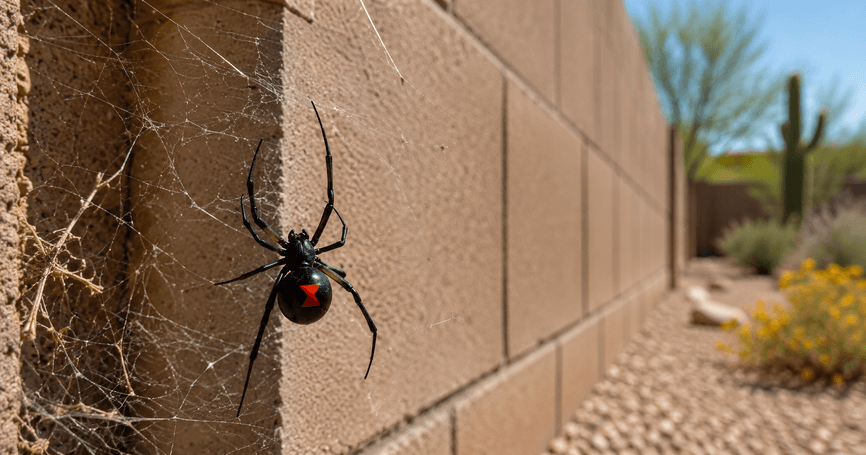
The western black widow is the one most Arizonans can already picture. University of Arizona Extension describes the adult female by “their shiny black color and red hourglass pattern on the underside of their abdomen.” Males and juveniles look different, smaller, with orange, red, and white markings on the back and sides.
Behavior is the other tell. Black widows are “shy and secretive and found in seldom-disturbed areas”, think block-wall weep holes, irrigation and water-meter boxes, the underside of patio furniture, garage corners, and cluttered storage. Their web is a messy, strong, irregular tangle rather than a neat wheel, and the female often guards a round, papery egg sac. The western black widow is the only black widow species found in Arizona, so if you see that red hourglass, you’ve identified it.
Is the brown recluse in Arizona?
Not the way people fear. The recluse that lives in Arizona is the Arizona recluse (Loxosceles arizonica) a native, seldom-seen desert species not the notorious brown recluse (Loxosceles reclusa) of the Midwest and South. University of Arizona Extension lists the Arizona recluse, not the brown recluse, as one of the state’s two venomous spiders.
To identify it, Extension points to two features: “a distinctive violin-shaped darker marking on the cephalothorax, with the neck of the violin pointed toward the abdomen,” and a distinctive eye pattern, “three pairs of eyes arranged in a semicircle” (most spiders have eight eyes). You’ll likely need a hand lens to see the eyes, which tells you how rarely people actually get close enough to confirm one.
Here’s the part that saves a lot of needless worry: many bites blamed on recluses were never caused by a spider at all. Extension notes that “bites from blood-feeding insects (kissing bugs, bird bugs, bat bugs, and bedbugs) are often mistaken for spider bites,” along with skin reactions to chemicals and underlying health conditions. If you have a wound and no spider, a recluse is one of the less likely explanations in Arizona.
How dangerous are Arizona spider bites?
Serious, but far less deadly than their reputation. Black widow venom is a neurotoxin, and Mayo Clinic lists typical bite symptoms as pain and swelling at the site, then possible severe abdominal cramping, muscle pain and rigidity, nausea, sweating, and rarely trouble breathing. Recluse bites usually start as mild pain and can, in some cases, develop into a slow-healing sore or ulcer.
The data is reassuring. A 2012-2022 review of the National Poison Data System found antivenom was administered in only 3.4% of black widow exposures, and per NIH/StatPearls, no deaths were attributed to widow-spider bites in the U.S. in that period, mortality is well under 1%.

Only 3.4% of US black widow exposures required antivenom (2012-2022); no deaths were recorded.
That said, treat a suspected black widow or recluse bite as worth medical attention, especially for children, older adults, or anyone with severe symptoms. Clean the bite with soap and water, apply a cool compress, and seek care if serious symptoms develop. Arizona’s Poison & Drug Information Center staffs a free 24/7 hotline at 1-800-222-1222.
What attracts spiders into your home?
Spiders follow food. University of Arizona Extension is direct about it: spiders get indoors “because they were attracted to the prey insects living in and around your house,” or because you carried them in on firewood, boxes, and stored materials. Extension’s blunt summary: “The more insects there are inside a building, the more likely it is to have spiders living there.”
That reframes the whole problem. A spider issue is usually a bug issue, crickets, roaches, and other prey drawing predators indoors. Exterior lighting that attracts insects at night, clutter that offers shelter, and gaps around doors and windows all stack the odds in the spider’s favor.
6 ways to keep spiders out of your Arizona home
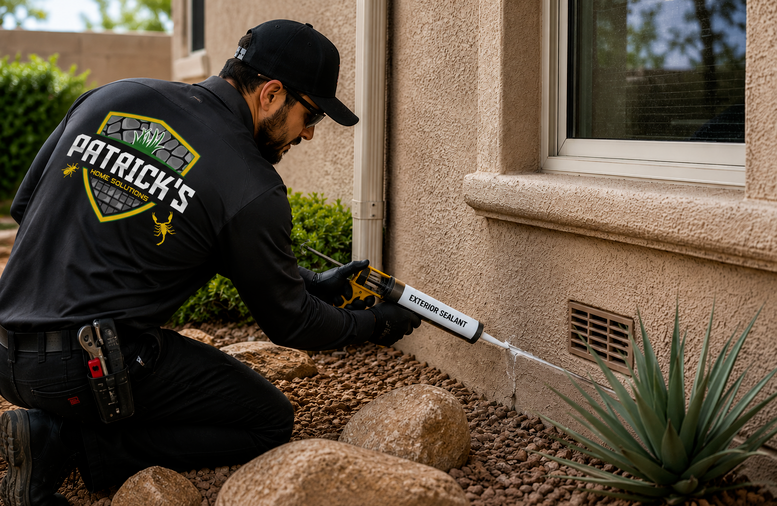
Spider prevention is really two jobs: take away the food, and close the doors. University of Arizona Extension’s recommended prevention is “weather stripping doors, repairing screens, caulking, and controlling prey insect populations.” Here’s how that plays out at home:
- Control the insects first. Reduce the crickets, roaches, and other prey and you remove the reason spiders move in. This is where recurring pest control does the heavy lifting.
- Seal entry points. Caulk cracks, weather-strip doors, repair torn screens, and close gaps around pipes and weep holes. This is the same exclusion work behind our home sealing service and it stops scorpions too.
- Declutter harborage. Clear boxes, piles, and undisturbed storage in garages, closets, and sheds where widows like to hide.
- Knock down webs and egg sacs. Regularly sweep away webs, especially in garage corners, eaves, and around patio furniture; remove egg sacs before they hatch.
- Manage exterior lighting. Bug-attracting lights near doors bring the buffet to your threshold. Switch to less-attractive bulbs or move fixtures away from entries.
- Shake out the usual hiding spots. Wear gloves when moving firewood or reaching into stored materials, and check shoes and gloves left in the garage.

When should you call a professional?
Call a pro when you’re repeatedly finding black widows, spotting egg sacs, dealing with a bug problem that keeps feeding the spiders, or you simply have kids and pets and want the risk handled. University of Arizona Extension advises that for a severe infestation you “work with professional pest control experts who can apply chemical treatments… in conjunction with sanitation and trapping.” A professional treats the perimeter, knocks down harborage, and — most importantly, goes after the insects the spiders are hunting.
At Patrick’s Home Solutions, we’re locally headquartered, licensed and insured (Lic# 9794), and serve the entire West Valley. Spider control is exactly the kind of layered, exclusion-first work we do every day.
Seeing black widows around the house? Call (623) 640-0405 for a free estimate, or request a quote online. We’ll treat the perimeter, seal the gaps, and knock out the insects drawing spiders in.
Frequently asked questions
What is the most dangerous spider in Arizona?
The western black widow is Arizona’s most medically significant spider. Its neurotoxic venom can cause painful cramping and muscle symptoms, but bites are rarely dangerous with care U.S. data shows antivenom is needed in only about 3.4% of cases and deaths are exceptionally rare.
Are there brown recluse spiders in Arizona?
The notorious brown recluse of the Midwest is not Arizona’s recluse. University of Arizona Extension identifies the native Arizona recluse (Loxosceles arizonica) as the state’s recluse species a shy, seldom-encountered desert spider, not the brown recluse people usually mean.
How do I keep spiders out of my house?
Control the insects spiders eat, then seal them out: caulk cracks, weather-strip doors, repair screens, declutter storage, sweep away webs and egg sacs, and reduce bug-attracting exterior lighting. Recurring pest control plus exclusion is the most reliable combination.
What does a black widow bite feel like?
Per Mayo Clinic, a black widow bite may cause pain and swelling at the site followed by severe abdominal or muscle cramping, nausea, and sweating. Symptoms can be intense but are treatable. They seek medical care, especially for children or severe reactions.
Is that wound actually a spider bite?
Often not. University of Arizona Extension notes bites from kissing bugs, bed bugs, and other insects plus skin reactions and health conditions are frequently mistaken for spider bites. If you have a wound but never saw a spider, a spider bite is far from the only explanation.
Sources
- University of Arizona Cooperative Extension, Backyard Gardener #177, “Spiders” (2024) https://extension.arizona.edu/sites/extension.arizona.edu/files/attachment/Spiders.pdf (retrieved 2026-07-08)
- Mayo Clinic, “Spider bites: First aid” https://www.mayoclinic.org/first-aid/first-aid-spider-bites/basics/art-20056618 (retrieved 2026-07-08)
- National Poison Data System review of Latrodectus exposures, 2012–2022 (PubMed) https://pubmed.ncbi.nlm.nih.gov/39670790/ (retrieved 2026-07-08)
- NIH / StatPearls, “Black Widow Spider Toxicity” https://www.ncbi.nlm.nih.gov/books/NBK499987/ (retrieved 2026-07-08)
- Arizona Poison & Drug Information Center, “Arthropods” https://azpoison.com/venom/arthropods (retrieved 2026-07-08)
About the author: Patrick Hagan is the owner of Patrick’s Home Solutions, a licensed and insured pest, wildlife, weed, and pigeon control company (AZ Lic# 9794) serving the Phoenix West Valley since 2016. The team specializes in exclusion-first solutions that keep spiders, scorpions, rodents, and other desert pests out of West Valley homes.
This article is for general educational purposes and is not medical advice. If you or a family member has a serious spider bite reaction, seek medical care immediately or call the Arizona Poison & Drug Information Center at 1-800-222-1222.
Ready for a Pest-Free Home?
Don't wait for pests to become a bigger problem. Contact Patrick's Home Solutions today for fast, reliable service across the Phoenix Valley.