
Africanized ‘Killer’ Bees in Arizona: Safety & Removal Guide
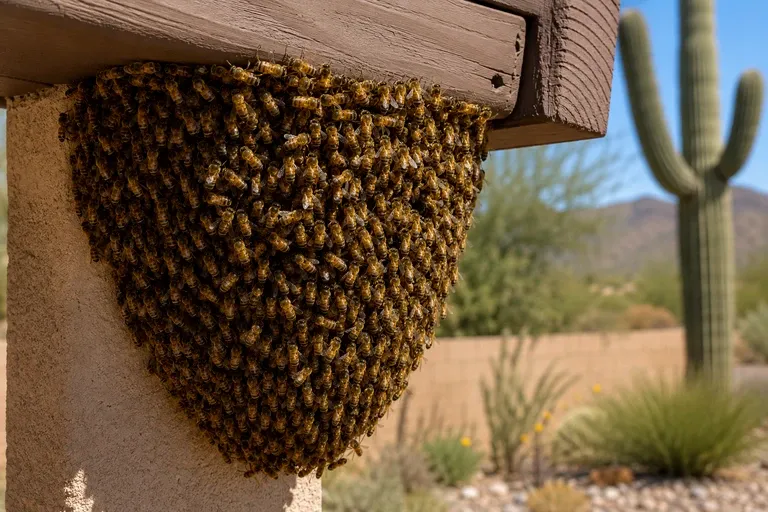
A wild honey bee swarm clustered on a structure in the Arizona desert
Key Takeaways
- In Arizona you should treat every wild honey bee colony as Africanized. "An expert with KJZZ / Northern Arizona University notes there are essentially no wild European honey bees left in the state.
- Africanized bees aren’t more venomous per sting, they’re far more defensive, and they can chase you more than a quarter mile, per the USDA Forest Service.
- If bees attack: run in a straight line to an enclosed shelter and keep going — do NOT swat, stand still, or jump in water (they wait for you to surface).
- Deaths are rare, but seek medical care if you’re stung more than 15 times, feel ill, or have trouble breathing.
- Never spray or open an established hive yourself — it needs professional removal and exclusion.
Arizona has one of the highest populations of Africanized honey bees in the country, and the practical takeaway is simple: respect every wild hive. The good news is that bees don’t attack at random, they defend a nest. Knowing how to spot one, how to react if you’re caught out, and how to keep bees from nesting on your property is what keeps you and your family safe.
Are all the bees in Arizona “killer bees”?
Effectively, yes. As beekeeping expert Patrick Pynes told KJZZ, “There are no European honeybees still in the wild that are not interacting in a beekeeping situation with humans.” In other words, the wild honey bee population across Arizona is now Africanized.
“Africanized” describes genetics and temperament, not a stronger sting. A single Africanized bee’s venom is essentially the same as a European honey bee’s. What differs is defensiveness: on a 0-10 scale where 0 is totally docile, Pynes places most Africanized bees he encounters “around five,” while “the European honeybee is around zero to three.” That gap, more bees responding, faster, in greater numbers, is the whole danger.
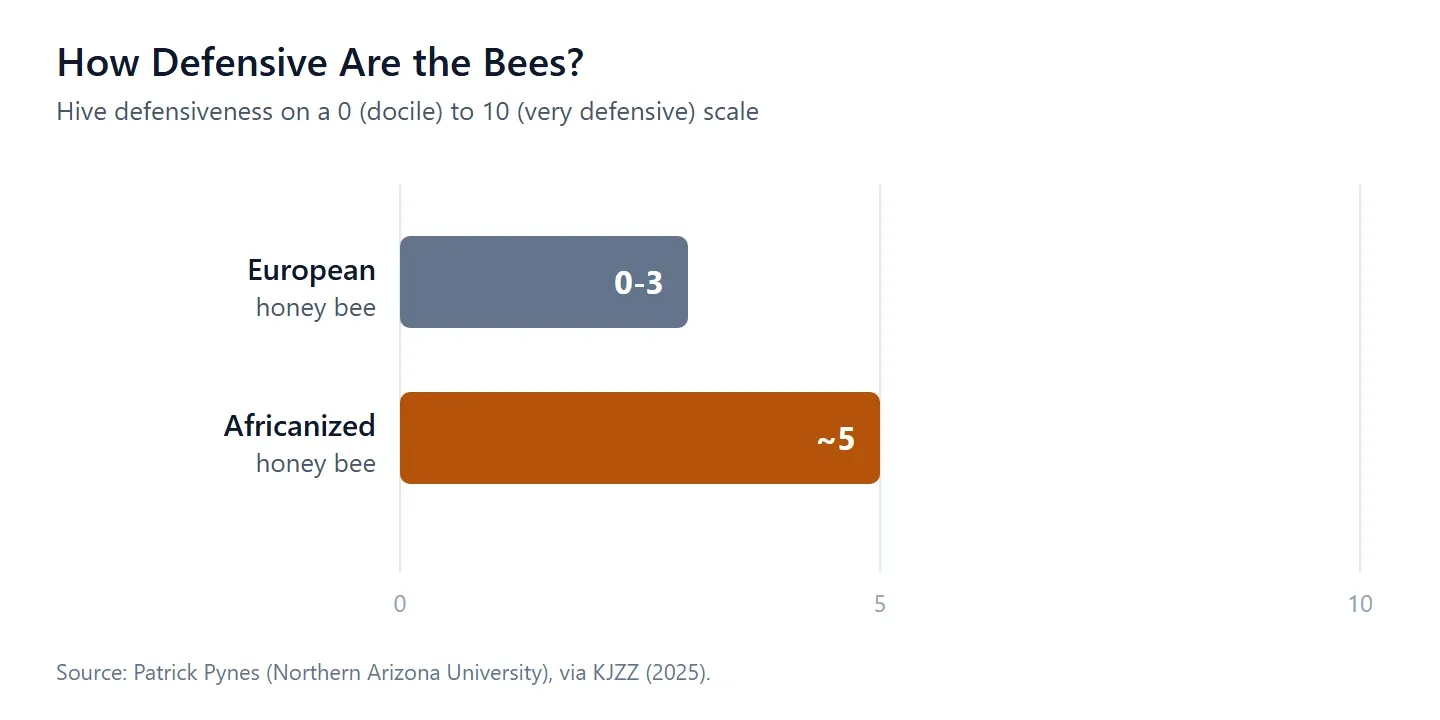
Hive defensiveness: Africanized bees (~5/10) are far more defensive than European bees (0-3).
How dangerous are Africanized bees, really?
Serious, but rarely fatal. Banner Health officials, via KJZZ, note that “Africanized bee attacks are common in Arizona. But multiple sting attacks are less common, and deaths are rare.” The threat isn’t one sting, it’s the volume of stings from a colony that mobilizes fast and pursues.
That pursuit is what surprises people. The USDA Forest Service warns that Africanized honey bees “may chase their victim for more than a quarter mile.” For anyone with a bee-sting allergy, even a single sting can trigger a dangerous reaction, so err on the side of caution.
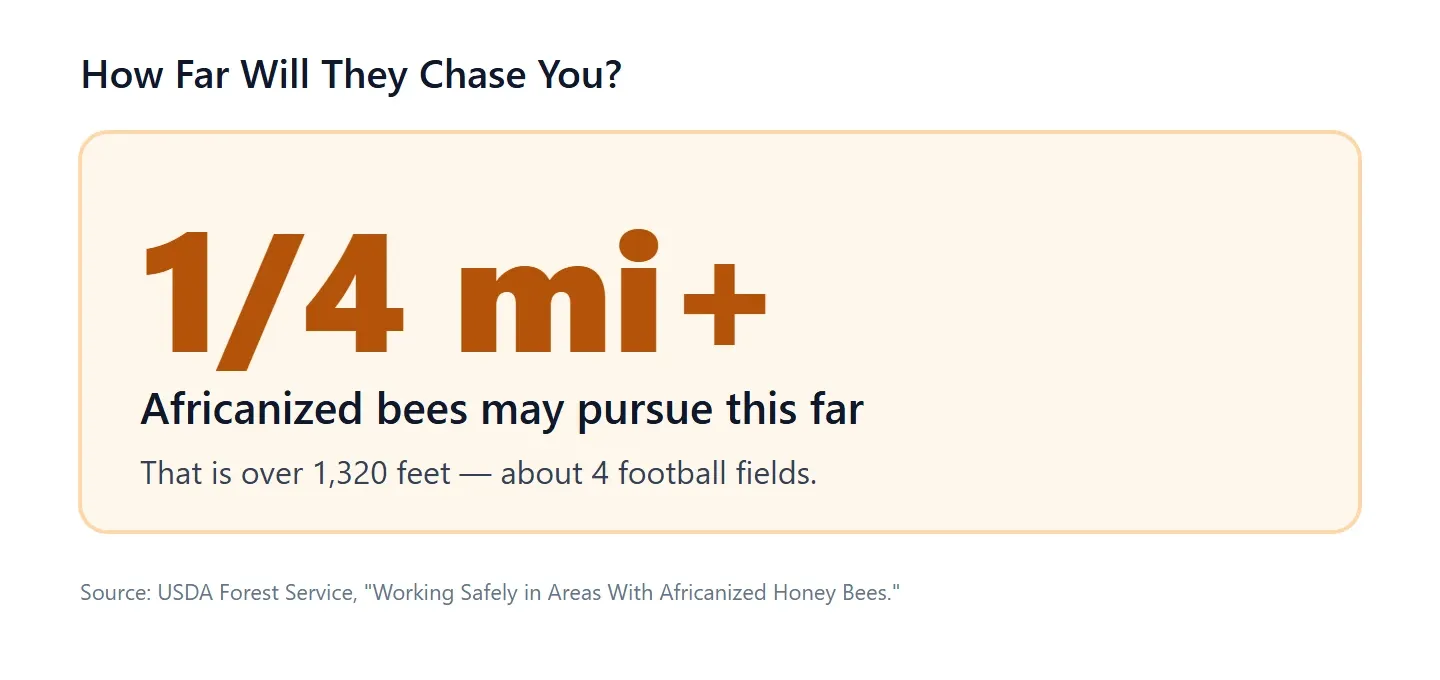
Africanized bees may chase a person more than a quarter mile (USDA Forest Service).
What triggers Africanized bees to attack?
Bees don’t attack out of nowhere, they defend a nest. Understanding the triggers helps you avoid setting one off. Africanized colonies are provoked by vibration and loud noise — lawn mowers, string trimmers, leaf blowers, and power tools near a hidden hive are classic culprits, as well as by movement close to the nest and by strong scents. The USDA Forest Service specifically warns that bees are attracted to movement, which is why swatting makes things worse. Once defensive, bees release an alarm scent that recruits more of the colony and marks a target, so an attack escalates fast.
The practical lesson: before running loud equipment around block walls, sheds, utility boxes, or anywhere you’ve seen bees coming and going, stop and look for a steady stream of insects entering one spot. A minute of caution beats a swarm and if you find an active colony, keep everyone clear until it’s professionally removed.
Bee or wasp, how do you tell them apart?
Knowing which insect you’re dealing with changes how it’s handled. Bees are fuzzy, feed on nectar and pollen, and build wax honeycomb. A honey bee colony in a wall can hold tens of thousands of insects and pounds of comb. Wasps (paper wasps, yellowjackets, hornets) are smooth and slender, are predators, and build papery nests under eaves, in attics, or underground.
Both sting, but the response differs. A small paper-wasp nest caught early is a much simpler problem than an established honey bee colony inside a wall void, which requires removing the bees and the comb to prevent odor, melting wax, and secondary pests.
Which wasps are common in Arizona?
Arizona’s stinging insects aren’t just bees. The wasps homeowners deal with most are paper wasps and yellowjackets, and they behave very differently from honey bees.
Paper wasps build the open, umbrella-shaped nests you see hanging under eaves, in door frames, patio ceilings, and grill lids. They’re slender and long-legged, and generally not aggressive unless the nest is disturbed, but a nest beside a frequently used door or window is worth removing before someone brushes it.
Yellowjackets are the more aggressive group. They often nest in the ground, in wall voids, or in cavities, and they scavenge for food and sugary drinks, which is why they crash patios, trash cans, and cookouts in late summer. They defend their nests fiercely and in numbers.
One critical difference from honey bees: a honey bee dies after a single sting, but wasps have smooth stingers and can sting repeatedly. That makes an established wasp nest near living space a genuine hazard, especially for anyone with a sting allergy or for children and pets. As with bees, a large, hidden, or hard-to-reach nest, particularly a ground or wall-void yellowjacket colony, is a job for a professional, not a can of spray.
What should you do if bees attack?
Run, and don’t stop. The USDA Forest Service and university extension programs give a clear, tested set of steps:
- Run away in a straight line toward an enclosed shelter, a car or building. Don’t stop until you’re inside and away from the bees’ defensive area.
- Cover your face and head with your shirt or whatever’s handy as you go; protect eyes and airway.
- Do not swat or flail — bees are attracted to movement.
- Do not jump into water. The bees will wait for you to come up for air.
- Don’t hide in place hoping they leave get distance.
Once you’re safe, scrape stingers out sideways with a fingernail or the edge of a credit card (don’t pinch them). Then watch for trouble.
When is a bee sting a medical emergency?
Seek medical attention right away if you’ve been stung more than 15 times, feel ill, or have any difficulty breathing, per USDA and university-extension guidance. Anyone with a known bee-sting allergy should treat even one sting seriously and use an epinephrine auto-injector if prescribed. Call 911 for a mass-sting attack or any breathing difficulty. Arizona’s Poison & Drug Information Center hotline is free 24/7 at 1-800-222-1222.
How do you keep bees and wasps from nesting on your home?
The goal is to close off the cavities they love and catch swarms early. West Valley bees frequently move into wall voids, water-meter and irrigation boxes, sheds, roof spaces, and block-wall openings.
- Seal wall voids, vents, weep holes, and gaps. This exclusion work is the same as our home sealing service and closes the entries bees exploit.
- Screen utility and irrigation boxes and cap open pipes.
- Inspect in spring, swarm season, and knock down new paper-wasp starts early.
- Remove standing water and food sources that draw insects to the yard, similar to the steps in our monsoon pest control guide.
- Act on the first signs of a nest, a steady stream of bees entering one small opening means a colony is forming.
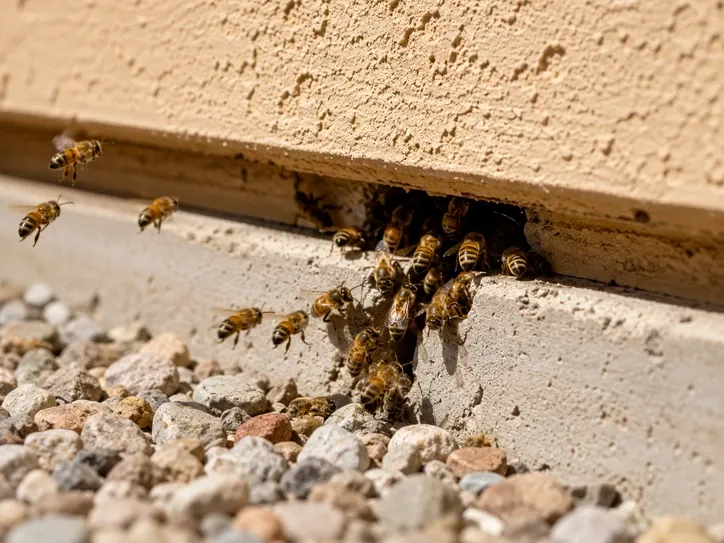
Honey bees entering a small gap in a home’s exterior wall, a common nesting entry
Should you remove a hive yourself?
No. An established colony belongs to a professional. Spraying a hive rarely kills all the bees, provokes defensive attacks, and, with honey bees, leaves pounds of wax and honey rotting inside your wall, which then attracts rodents, ants, and other pests. Safe resolution means removing the colony and the comb, then sealing the cavity so a new swarm doesn’t move in. That’s wildlife exclusion work, not a DIY spray can.
At Patrick’s Home Solutions, we’re locally headquartered, licensed and insured (Lic# 9794), and serve the entire West Valley. We handle stinging-insect problems safely, removal plus the exclusion that keeps them from coming back.
Bees or wasps setting up on your property? Call (623) 640-0405 for a free estimate, or request a quote online. Don’t risk a hive yourself, we’ll remove it and seal the openings for good.
Frequently asked questions
Are all bees in Arizona Africanized?
Effectively yes — the wild honey bee population in Arizona is Africanized, according to experts cited by KJZZ. That’s why safety guidance is to treat every wild colony as Africanized and never disturb a hive yourself.
What should you do if bees start chasing you?
Run in a straight line to an enclosed shelter like a car or building and keep going, the USDA Forest Service notes Africanized bees may chase for more than a quarter mile. Cover your face, don’t swat, and never jump in water, because the bees wait for you to surface.
Are Africanized bees more venomous than regular bees?
No. Their venom per sting is essentially the same as a European honey bee’s. The danger is behavioral: they defend the hive far more aggressively, in greater numbers, and pursue much farther.
How many stings are dangerous?
Seek medical care if you’re stung more than 15 times, feel ill, or have trouble breathing, per USDA and extension guidance. For anyone allergic, even a single sting can be an emergency, call 911 if breathing is affected.
How do I keep bees from nesting on my house?
Seal wall voids, weep holes, vents, and gaps; screen utility and irrigation boxes; inspect in spring; and act at the first sign of a colony. Professional exclusion closes the cavities bees use to nest.
Sources
- KJZZ (Northern Arizona University’s Patrick Pynes; Banner Health), “Q&AZ: Do the ‘killer bees’ in Arizona live up to their name?” (2025) https://www.kjzz.org/qaz/2025-05-30/q-az-do-the-killer-bees-in-arizona-live-up-to-their-name (retrieved 2026-07-08)
- USDA Forest Service, “Working Safely in Areas With Africanized Honey Bees” https://www.fs.usda.gov/t-d/pubs/htmlpubs/htm00672313/index.htm (retrieved 2026-07-08)
- USDA Agricultural Research Service, Carl Hayden Bee Research Center (Tucson), Africanized honey bee safety https://www.ars.usda.gov/pacific-west-area/tucson-az/carl-hayden-bee-research-center/docs/africanized-honey-bees/safety-precautions-for-school/ (retrieved 2026-07-08)
- Arizona Poison & Drug Information Center, “Arthropods” https://azpoison.com/venom/arthropods (retrieved 2026-07-08)
This article is for general educational purposes and is not medical advice. If you are stung many times or have any allergic or breathing reaction, call 911 immediately or contact the Arizona Poison & Drug Information Center at 1-800-222-1222.
About the author

Patrick Hagan
Owner, Patrick's Home Solutions
Patrick Hagan is the owner of Patrick's Home Solutions, a licensed and insured pest, wildlife, weed, and pigeon control company (AZ Lic# 9794) serving the Phoenix West Valley since 2016. The team specializes in identification-first, exclusion-based pest control that keeps cockroaches, scorpions, rodents, and other pests out of West Valley homes.
Read Patrick's storyReady for a Pest-Free Home?
Don't wait for pests to become a bigger problem. Contact Patrick's Home Solutions today for fast, reliable service across the Phoenix Valley.