
Roof Rats vs. Pack Rats in Arizona: ID, Risks & Removal
By Patrick Hagan — Licensed Pest Control Operator, AZ ODA License #9794
Here's a fact that surprises most Phoenix homeowners: roof rats aren't supposed to be here. They're a non-native species that first turned up in Maricopa County in the early 2000s and spread fast through the Valley's citrus-filled neighborhoods (University of Arizona Cooperative Extension, 2024).
So when something's rustling in your attic or hollowing out your grapefruit, which rat is it — the invader in your roofline, or the native desert pack rat building a fortress by your block wall? Telling them apart is the first step, because the two need different removal strategies. Let's break it down.
Key Takeaways
- Roof rats (non-native) climb and nest high; pack rats (native woodrats) build ground-level stick middens.
- Rats travel hundreds of feet along power lines to reach homes (UA Extension, 2024).
- Both gnaw wiring (a fire risk), damage citrus, and contaminate spaces with droppings.
- Trapping plus sanitation works short-term; sealing entry points (exclusion) is the only permanent fix.

Roof Rats vs. Pack Rats — How Do You Tell Them Apart?
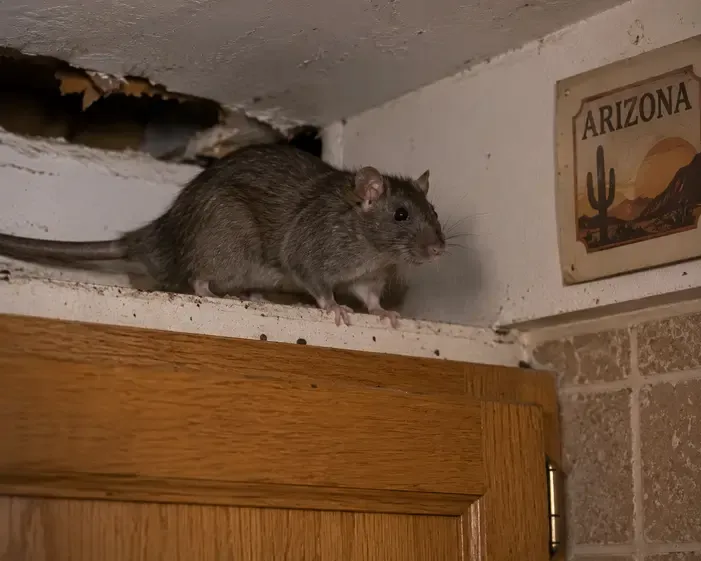
The quickest tell is where they nest. Roof rats are sleek, dark, agile climbers that nest high — attics, palm fronds, citrus canopies — while pack rats are stockier native woodrats that build bulky stick-and-debris middens on the ground near cactus, woodpiles, and walls. Same neighborhood, totally different habits.
Roof rats (Rattus rattus) have a tail longer than their body, large ears, and pointed snouts. They're the ones you hear scrambling overhead after dark. Pack rats (white-throated woodrats) have furrier tails, a habit of hoarding shiny objects, and they rarely climb into your attic.

Why does the ID matter? Because chasing a roof rat with a ground bait station, or a pack rat with attic traps, wastes weeks. Get the species right and the rest of the plan falls into place.
Why Are Roof Rats So Common in Phoenix?
Roof rats thrive in Phoenix because the Valley hands them everything they need: dense citrus, year-round irrigation, and a network of walls and power lines to travel on. According to the University of Arizona, rats can move hundreds of feet along power lines to reach homes (UA Extension, 2024). That's how one infested yard becomes a whole infested street.
Fallen fruit, birdseed, and pet food are rocket fuel for their numbers. A backyard orange tree dropping fruit is essentially a 24-hour buffet. They're active all year here, but populations and indoor sightings usually peak in fall as nights cool and rats look for warm shelter.
What Damage and Diseases Do They Cause?
Both rats cause two kinds of harm: structural damage from constant gnawing, and contamination from droppings and urine. Their feeding and gnawing can completely girdle young trees, and chewing on wiring inside walls, attics, and vehicles creates a genuine fire hazard (UA Extension, 2024).
Roof rats love citrus — they hollow out oranges, grapefruit, and lemons and leave the rinds hanging, a classic sign of an active infestation. Pack rats focus their gnawing lower down, which is why they're notorious for shredding the wiring and hoses inside parked cars near desert edges.
There's a health dimension as well. Rodent droppings and urine can spread disease and trigger allergies, and droppings should never be swept up dry — that sends contaminated dust airborne (CDC, 2025). Cleanup deserves the same caution you'd give any biohazard.

What Are the Signs of an Infestation?
The signs are easy to spot once you know them: hollowed citrus with the rind left behind, scratching or scampering sounds in the attic at night, and dark grease rub-marks along beams and pipes where rats travel the same routes.
Add to that pea-sized droppings near food sources, gnaw marks on wood and wiring, and a dog or cat suddenly fixated on a wall or ceiling. Outside, a bulky pile of sticks, cactus pads, and trash tucked against a wall or under a shed is a pack rat midden. Finding any two of these together means it's time to act.
How Do You Get Rid of Roof Rats and Pack Rats?
Effective removal follows a strict order: trap and sanitize first, then exclude. Snap traps placed along travel routes knock down the active population quickly, but trapping alone never ends the problem — rats simply move back in along those same power lines and walls.
The permanent step is exclusion: sealing every gap a rat can use. Mice and rats exploit openings as small as a quarter-inch, so roofline gaps, vent screens, weep holes, and pipe penetrations all get sealed with rodent-proof materials. Pair that with habitat reduction — pick up fallen citrus, secure pet food, trim trees off the roof, and clear woodpiles and pack rat middens away from the house.
The number-one entry point we find on West Valley homes is the gap where the roofline meets the soffit above the garage. It looks like nothing from the ground, but it's a freeway for roof rats. Our wildlife exclusion service maps and seals these access points so the rats you trap can't be replaced by the next ones over.

How Do You Keep Them From Coming Back?
Prevention is exclusion plus ongoing yard discipline. Once entry points are sealed, the job is keeping the property unattractive: fruit picked up, trash secured, vegetation trimmed, and irrigation leaks fixed so there's no easy water.
Seasonal pressure matters too. As monsoon storms green up the desert and fall cooling pushes rodents indoors, a quick inspection catches new gaps before they become nests. Our broader pest control program pairs naturally with that seasonal rhythm — see how monsoon weather shifts pest pressure in our Arizona monsoon pest guide.
Frequently Asked Questions
Are pack rats native to Arizona?
Yes. Pack rats (white-throated woodrats) are native desert rodents that build stick middens on the ground near cactus and walls. Roof rats are a non-native invasive species that first appeared in Maricopa County in the early 2000s (UA Extension, 2024).
How do I know if I have roof rats or pack rats?
Roof rats are sleek climbers that nest high and hollow out citrus; pack rats are stockier, build bulky ground-level stick nests, and hoard objects. Scratching in the attic at night points to roof rats; a stick midden by a wall points to pack rats.
Why do pack rats chew car wiring?
Pack rats gnaw constantly to file down their teeth, and a warm engine bay is inviting shelter. Wiring, hoses, and insulation are easy targets, and repairs can run into hundreds or thousands of dollars — especially in homes near desert edges.
Will poison alone get rid of roof rats?
No. Poison may cut numbers briefly, but rats reinfest along power lines and walls, and a dead rat in a wall causes odor and secondary-poisoning risk. Lasting control needs exclusion — sealing entry points — plus sanitation and habitat cleanup.
When are roof rats most active in Phoenix?
They're active year-round but usually peak in fall, when cooler nights push them toward warm attics and ripening citrus fuels fast population growth.
The Bottom Line
Roof rats and pack rats share your Phoenix neighborhood but live very different lives — one overhead, one on the ground. Identify which you're dealing with, knock down the active population, and then seal the home so the next wave can't get in.
- Roof rats climb and nest high; pack rats build ground middens.
- Both gnaw wiring and contaminate spaces; cleanup needs care.
- Trapping is temporary — exclusion is permanent.
- Yard sanitation keeps them from coming back.
Hearing something in the attic? Call Patrick's Home Solutions at 623-640-0405 for a free wildlife-exclusion inspection.
About the author: Patrick Hagan is a Licensed Pest Control Operator (Arizona Department of Agriculture License #9794) and owner of Patrick's Home Solutions, serving the Phoenix Valley.
Sources
- University of Arizona Cooperative Extension, Roof Rat Control around Homes and Other Structures (AZ1280), retrieved 2026-06-18, https://extension.arizona.edu/sites/extension.arizona.edu/files/pubs/az1280.pdf
- Centers for Disease Control and Prevention, Rodents and disease / cleanup guidance, retrieved 2026-06-18, https://www.cdc.gov/
Ready for a Pest-Free Home?
Don't wait for pests to become a bigger problem. Contact Patrick's Home Solutions today for fast, reliable service across the Phoenix Valley.